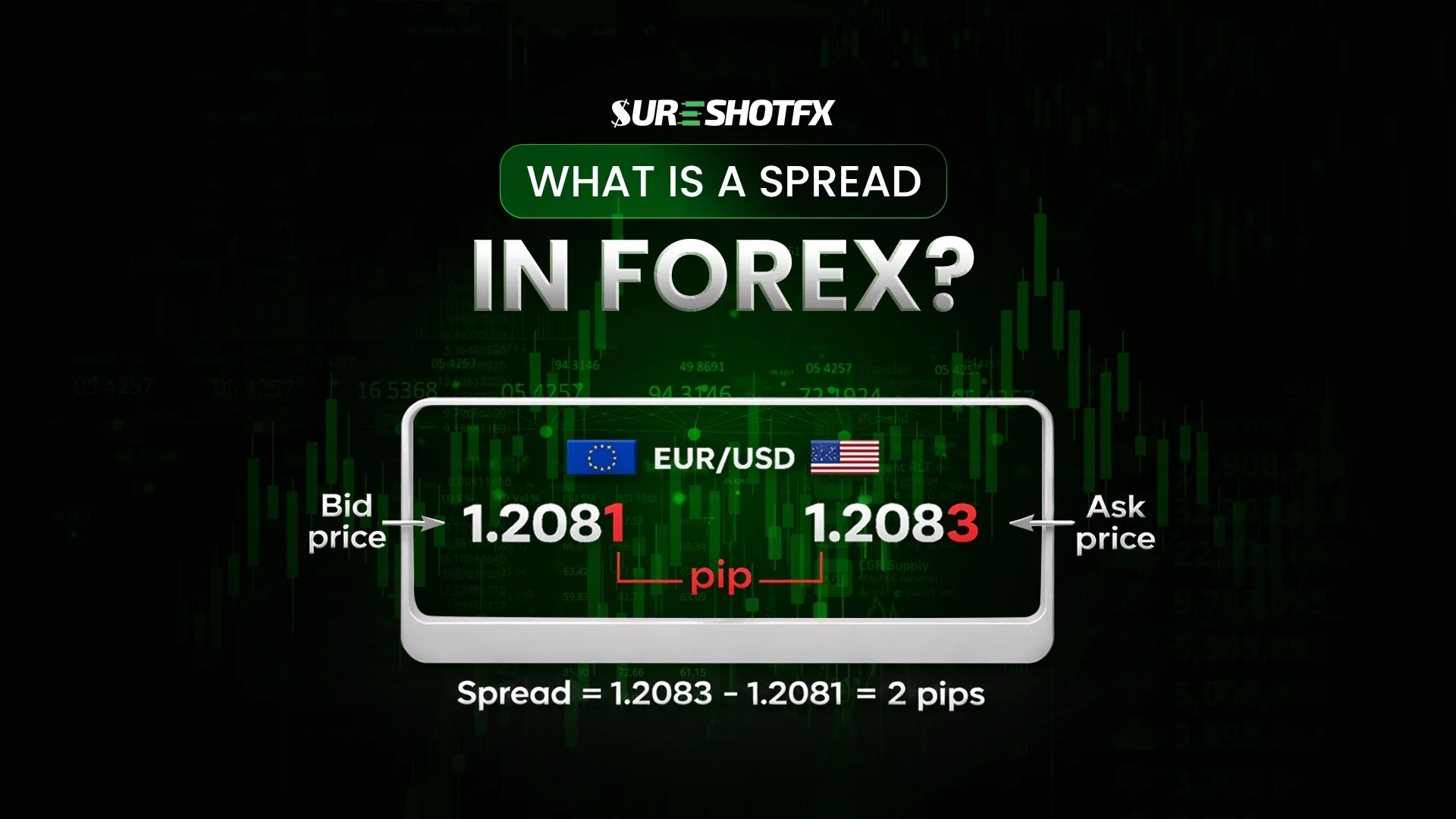
10. What is a Spread in Forex?
Understanding what is a spread in forex is one of the first steps every new trader must take. In simple terms, the forex spread is the difference between the bid price and the ask price of a currency pair. This difference represents the cost of entering a trade and is how brokers earn revenue for providing access to the market.
In forex trading, currencies are always quoted in pairs, and prices are constantly moving. Instead of charging a separate fee, most brokers build their trading cost directly into this spread. Grasping the forex spread meaning early helps traders set realistic expectations, manage costs, and make informed decisions before opening any position.
How the Forex Spread Works (Bid Price vs Ask Price)
To fully understand spreads, you need to know how forex prices are quoted. Every currency pair has two prices: the bid price and the ask price. The bid price is the rate at which the market is willing to buy the base currency from you, while the ask price is the rate at which the market sells the base currency to you.
This two-price system exists because brokers and liquidity providers need a margin to facilitate trades and the spread is always measured in pips.
When you open a trade, you buy at the ask price and sell at the bid price. As a result, your trade starts slightly negative until price movement covers the spread. Every forex price quote you see already includes this built-in trading cost.
Forex Spread Calculation with Example
Understanding how to calculate forex spread is essential for traders because the spread represents the primary cost of entering a trade.
Let’s look at a simple Forex spread calculation.
Forex Spread Formula:
Forex Spread = Ask Price − Bid Price
For example, let’s consider a real-world trading scenario using the EUR/USD currency pair. Suppose your broker displays the following prices:
- Bid Price: 1.1050
- Ask Price: 1.1052
Using the formula, the spread would be:
1.1052 − 1.1050 = 0.0002, which equals 2 pips. This means the cost of opening the trade is 2 pips, and the market must move at least 2 pips in your favor for the trade to break even.
To calculate the monetary value of the spread, you multiply the number of pips by the pip value of your trade size. For a standard lot (100,000 units) in EUR/USD, one pip is typically worth $10. Therefore, a 2-pip spread would cost $20 to enter the trade.
This calculation helps traders compare brokers, evaluate trading costs, and choose strategies that align with their risk management and profit goals.
Types of Forex Spreads
Forex spreads are not the same across all accounts or brokers. Understanding the types of Forex spreads helps traders choose the right account structure and strategy. Broadly, spreads are classified into fixed, variable, and zero spread models.
Fixed Spreads
A fixed spread in Forex remains constant regardless of market conditions. Whether the market is calm or volatile, the spread does not change. Fixed spreads are commonly offered by dealing-desk brokers.
The main advantage of fixed spreads is predictability. Traders always know their transaction cost in advance, which is helpful for beginners and strategy planning. However, fixed spreads are usually wider than floating spreads during normal market conditions. During major news events, brokers may also limit execution or reject orders.
Variable (Floating) Spreads
A variable spread in Forex, also known as a floating spread, changes continuously based on market conditions. When liquidity is high and volatility is low, floating spreads can become extremely tight. When volatility spikes or liquidity drops, spreads widen.
Floating spreads reflect real market behavior and are commonly offered by ECN and STP brokers. These spreads tend to be lower during active trading sessions but can widen significantly during news releases or low-volume periods. Traders who understand volatility dynamics often prefer floating spreads in Forex because they provide more competitive pricing during normal market conditions.
Zero Spread Accounts
Zero spread Forex accounts are often misunderstood. These accounts advertise spreads close to zero, but trading is not free. Instead of charging through spreads, brokers apply a commission-based trading model. Prices are sourced directly from liquidity providers, also known as raw spread accounts.
Zero spread does not mean zero cost. Traders pay a fixed commission per lot traded. These accounts are popular among scalpers and professional traders who need precise pricing and fast execution. Understanding the difference between marketing claims and actual trading costs helps traders avoid unrealistic expectations.
Spread Differences Between Major, Minor, and Exotic Pairs
Not all currency pairs have the same spread. Major currency pairs, such as EUR/USD, GBP/USD, and USD/JPY, typically have the lowest spreads because they are highly liquid and actively traded. These pairs benefit from tight pricing and stable execution.
Minor pairs have slightly higher spreads due to lower liquidity and less trading volume.
Exotic Forex pairs, which involve emerging market currencies, usually have the widest spreads. Exotic Forex pair spreads are higher because of increased risk, lower liquidity, and higher volatility.
Understanding these differences helps traders choose instruments that align with their risk tolerance and strategy.
Key Takeaways: Understanding Forex Spreads as a Trader
Forex spreads represent the hidden but unavoidable cost of trading. Understanding how spreads work, how they are calculated, and how they vary across account types and currency pairs gives traders a significant edge. A tight spread improves trade efficiency, while wide spreads increase the distance needed to reach profitability.
By mastering forex spread explained concepts and developing a mindset focused on cost control, traders can make smarter decisions, manage risk more effectively, and align their strategies with real market conditions.
What have you learned today—
- Understanding what is a spread in forex and how it helps traders.
- The bid price and ask price.
- A practical forex spread calculation with example.
- Different types of forex spreads.