
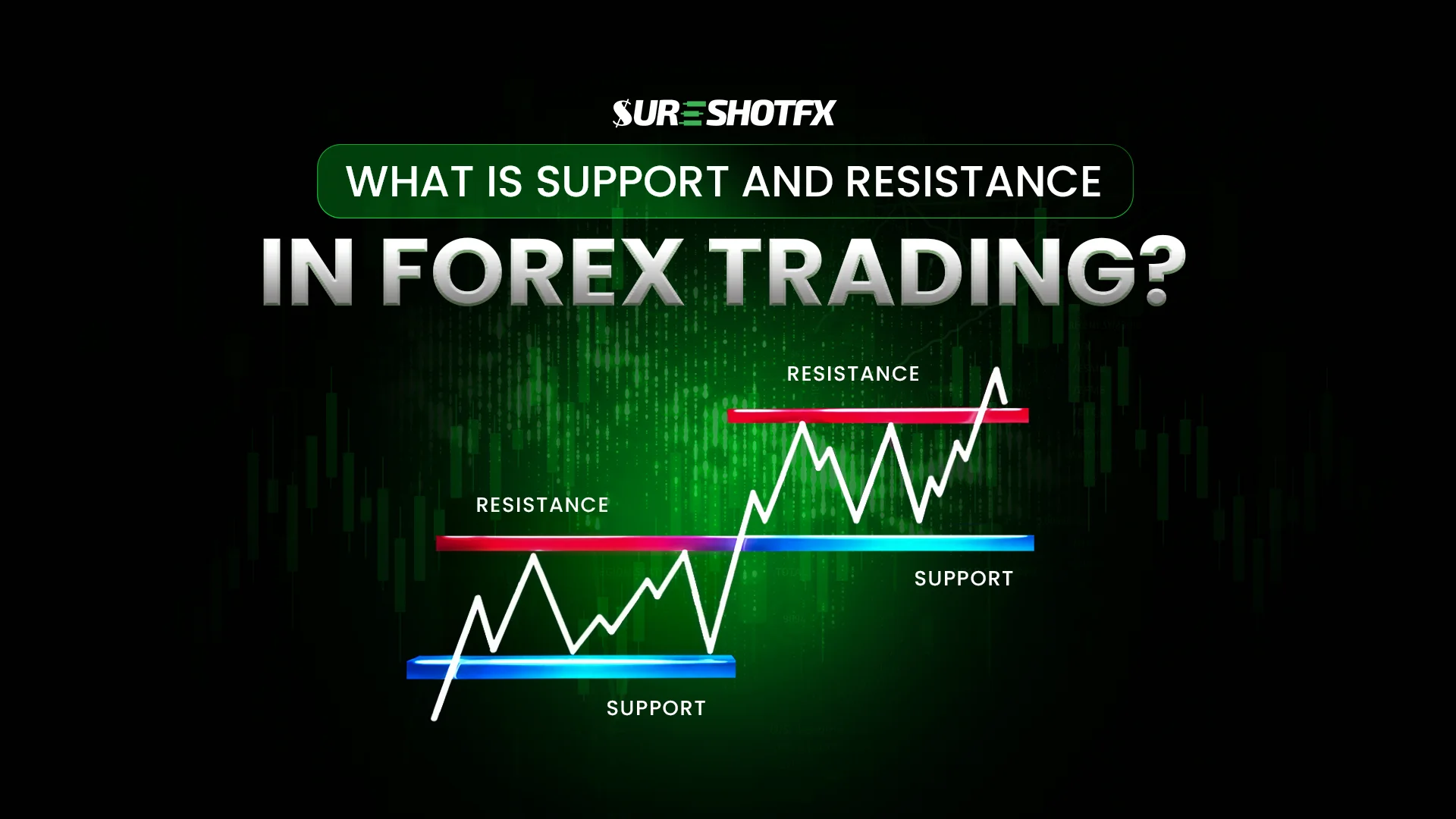
12. What is Support and Resistance in Forex Trading?
Support and resistance in forex trading are foundational price levels where the market tends to pause, reverse, or consolidate. Support is a price level where buying interest is strong enough to stop price from falling further. Resistance is the opposite—a level where selling pressure prevents prices from rising higher.
These price levels exist because markets are not random; they are driven by human behavior, institutional orders, and collective expectations. These levels act as decision zones where the market often pauses, reverses, or accelerates. In simple terms, support and resistance help traders understand where price is likely to react and why those reactions happen.
Traders use them to plan entries, exits, stop-loss placements, and profit targets. In short, understanding support and resistance in forex is a core part of forex trading basics and a gateway to reading price with clarity instead of guesswork.
What is Support in Forex Trading?
Support in forex trading refers to a price level where downward movement consistently slows or stops due to increased buying pressure. It represents a demand zone where buyers believe the price offers value. When price approaches support, traders expect buyers to step in, absorbing selling pressure and pushing price higher.
When price approaches support, sellers begin to lose control as buyers enter the market. This increase in buying pressure in forex causes price to either bounce upward or consolidate. Support does not have to be a single exact price—it is often better viewed as a zone where demand consistently outweighs supply.
How Support Levels Are Formed
Support levels are not accidental. They form through institutional buying zones where large players accumulate positions without causing sharp price spikes. Since institutions trade large volumes, they often spread orders across specific price ranges, creating a support zone rather than a single line.
What is Resistance in Forex Trading?
Resistance is the opposite of support. Resistance in forex trading is a price level that acts as a ceiling, limiting upward price movement. It forms when selling pressure becomes stronger than buying pressure, preventing price from moving higher. Traders view resistance levels as areas where price is expensive or overvalued.
How Resistance Levels Are Formed
Resistance forms because sellers dominate these zones. Institutional traders may distribute positions here, while retail traders take profits or open sell trades. As price approaches resistance, sell orders cluster, increasing supply and preventing further upward movement unless buyers overwhelm sellers.
At resistance, sellers believe price is overvalued and begin to exit or short positions. This selling zone causes prices to stall, reverse, or consolidate. Understanding resistance helps traders avoid buying at unfavorable levels and identify potential reversal points.
How to Identify Support and Resistance Levels (Step-by-Step)
Using Swing Highs and Swing Lows
Swing highs and swing lows define market structure in forex. A swing low often acts as support, while a swing high functions as resistance. Identifying these points helps traders map the natural rhythm of price movement and locate high-probability levels.
Drawing Horizontal Support and Resistance
Horizontal levels are drawn across areas where price has reacted multiple times. The goal is not precision but relevance. Focus on zones rather than exact lines, highlighting key levels forex traders consistently respect.
Using Trendlines as Dynamic Levels
Trendlines act as dynamic support and resistance. In an uptrend, rising trendlines serve as support. In a downtrend, falling trendlines act as resistance. These dynamic levels adjust with price and reflect ongoing market momentum.
Using Indicators to Confirm Levels
Indicators can confirm support and resistance but should not replace price analysis. Moving averages often act as dynamic levels. Fibonacci retracement highlights potential reaction zones based on market structure. Advanced traders may also use VWAP to identify institutional value areas.
Final Thoughts
Support and resistance form the forex trading foundation for nearly all strategies. Whether you trade breakouts, reversals, or trends, these levels guide decision-making and risk control. Mastering them improves consistency and confidence over time.
As you advance, learning price action trading and chart patterns will naturally build on this knowledge. Support and resistance are not just tools—they are the language of the market itself.
This is what you learned today—
- Support and resistance in forex trading
- What Support represents
- What Resistance represents
- How these levels are formed
- How Traders can identify these levels