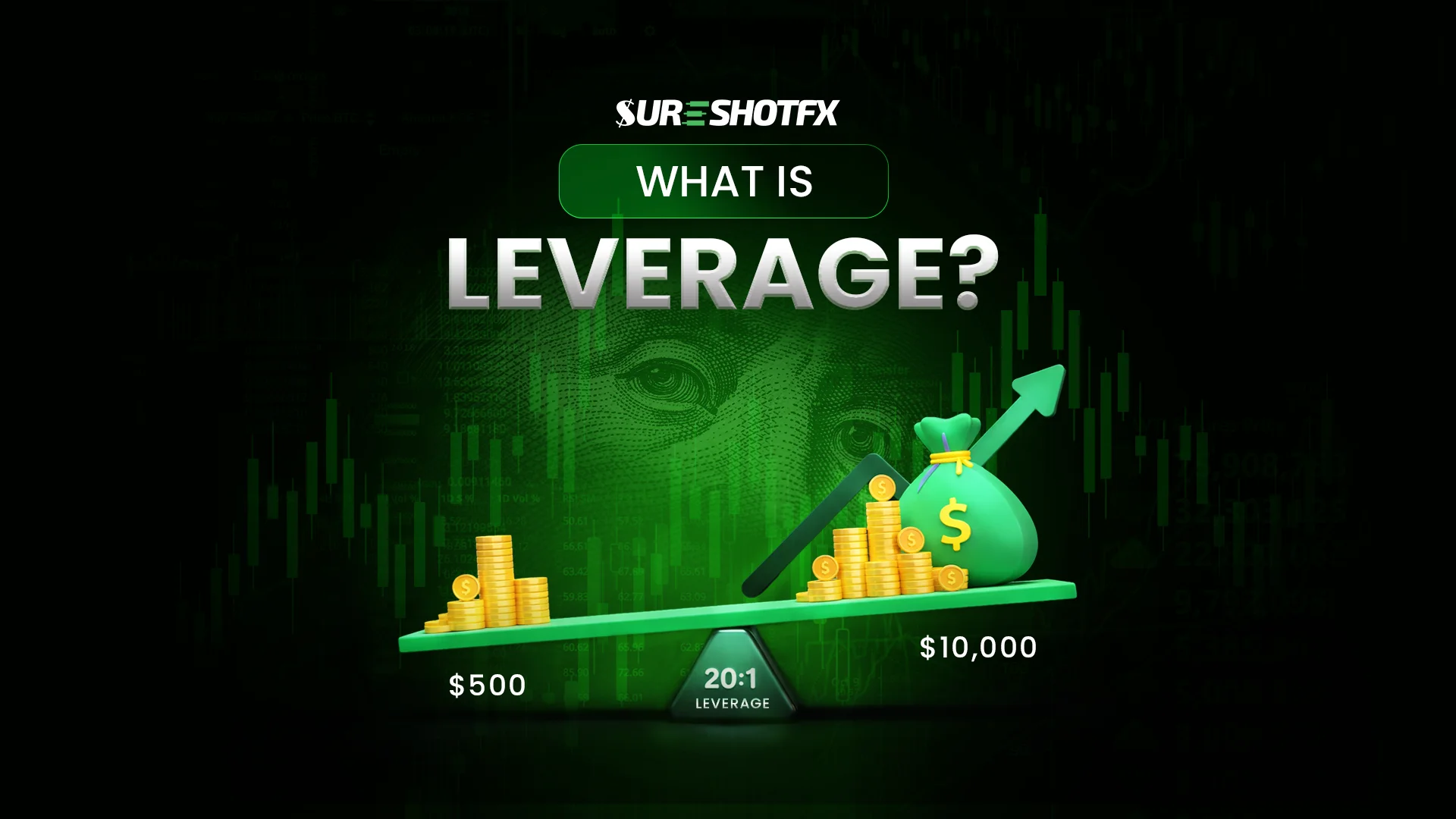
08. What is Leverage in Forex?
Leverage is a financial tool that allows traders to control a larger market position using a relatively small amount of their own money. In simple terms, leverage means borrowed exposure, not free money. When you trade with leverage, your broker lends you capital so you can open positions bigger than your actual account balance.
In trading, leverage magnifies outcomes. This means it can multiply profits when a trade moves in your favor, but it can just as easily magnify losses when the market moves against you. This is why understanding leverage in trading is critical before using it in real market conditions. Financial leverage does not change market direction—it only increases the impact of your decisions.
How Leverage Works?
To understand how leverage works, imagine combining your own money with borrowed capital to increase your market exposure. Your capital is called equity, and the borrowed portion usually comes from a broker or financial institution. Together, they allow you to enter a position larger than what your equity alone would permit.
This leverage mechanism amplifies outcomes. If the market moves in your favor, gains are calculated on the full position size, not just your initial capital. However, if the market moves against you, losses are also calculated on that larger position. This is why leverage increases both profit potential and risk.
At its core, leverage relies on debt. You are temporarily using borrowed capital with the expectation that the market move will justify that exposure. Understanding this relationship between debt and equity is crucial before applying leverage in real market conditions.
Why is Leverage Popular in Forex Trading?
Leverage is especially common in forex trading because of how the forex market operates. Currency markets are highly liquid, meaning trades can be executed quickly with minimal price gaps. Price movements in major currency pairs are usually small, often measured in fractions of a percent.
Another reason is price movement. Currency pairs usually move in small increments. Without forex leverage, these small changes would produce very limited returns. Leverage allows traders to make meaningful gains from relatively small price fluctuations.
Forex leverage allows traders to make those small movements meaningful. Without leverage, potential returns from minor price changes would be limited unless traders used very large capital. This is one reason why forex uses leverage more than stocks.
Leverage Ratios and Formulas
A leverage ratio shows how much exposure you control relative to your actual capital. Common examples include 10:1, 50:1, or even 100:1. A 50:1 leverage ratio means you control $50 for every $1 of your own money.
The basic leverage formula is simple:
Leverage = Total Position Size ÷ Your Capital
These ratios help you measure risk, not profit potential alone. Higher leverage ratios increase sensitivity to market movements, meaning smaller price changes can have a bigger impact on your account. Beginners should view leverage ratios as a risk indicator rather than a performance enhancer.
When You Should and Shouldn’t Use Leverage?
Knowing when to use leverage depends on experience, risk tolerance, and market conditions. Traders with structured strategies, defined risk limits, and emotional discipline tend to handle leverage better than beginners.
Risk tolerance is another key consideration. If you are uncomfortable with rapid changes in account value, leverage may not align with your goals. Market conditions also matter. Highly volatile environments can amplify losses quickly, making leverage particularly dangerous.
For beginners, minimal leverage—or none at all—helps preserve capital while learning. Responsible leverage strategy focuses on position sizing and risk control rather than maximizing exposure. Education comes before optimization.
Is Leverage Good or Bad?
Leverage itself is neither good nor bad. It is a neutral tool. When used with discipline, leverage can improve capital efficiency. When used recklessly, it becomes destructive.
A common question is whether beginners should use leverage. Generally, beginners face higher risk because skill development takes time. Account size does not replace experience, and leverage does not create skill—it only magnifies decisions. The safer approach is learning first, then gradually understanding how leverage fits into a broader trading framework.
Final Takeaway – Understanding Leverage Before Using It
Leverage allows traders to control larger positions using borrowed capital. It increases both potential profit and potential loss. In forex trading, leverage exists because price movements are small and markets are highly liquid—but that does not reduce risk.
Understanding leverage means recognizing responsibility. Leverage does not improve strategy, timing, or skill. It simply amplifies the result of whatever decision you make.
Used carefully, leverage is a practical trading tool. Used blindly, it becomes a liability. Master the concept before applying it.
What You Learned Today-
- What leverage is
- How leverage works
- Why leverage is common in Forex trading
- Leverage ratios
- When to use leverage cautiously