Best Smartphones for Forex Trading: 2026 Performance Guide
Forex trading requires fast execution speed. In this market, milliseconds matter because execution speed directly impacts slippage. A smartphone with strong hardware affects trade timing, especially during high-volatility sessions like London–New York overlap.
The best smartphones for forex trading are not luxury gadgets; they are performance tools built to ensure fast execution speed, stable connectivity, and accurate trade timing. Mobile trading now enables on-the-go position management, and a vast number of younger traders, increasingly, prefer a mobile-based trading approach.
In this guide, we’ll break down what makes a mobile forex trading device reliable, fast, and capable of minimizing costly delays in live market conditions.
What is Mobile Trading?
Mobile trading is the execution of financial trades through a mobile trading app on a smartphone or tablet. A mobile trading app executes forex trades via smartphone and connects directly to a broker server. The broker server streams live price feeds, bid-ask spreads, and account data in real time.
Mobile trading has changed the way people participate in financial markets. Today, traders no longer need a full desktop setup to access global markets. With a mobile trading app, you can execute Forex trades via smartphone from almost anywhere in the world. It is very popular among young traders.
How Can You Trade on a Smartphone?
To get started, download a regulated broker’s app, verify your account, deposit funds, and customize charts. The app interface displays charts and indicators in real time, allowing the user to place market or pending orders within seconds. Think of it as a portable trading terminal. Instead of sitting at a desk, you can monitor currency pairs, analyze charts, and place trades while commuting, traveling, or even during a lunch break.
Many ask: Can you day trade on your phone effectively? Yes, if your mobile trading system requirements include strong processing power, sufficient RAM, and reliable connectivity.
Smartphone Specification for Forex Trading Performance
Modern forex trading pushes smartphones far beyond casual use. When hardware cannot keep up, latency increases slippage risk, low RAM causes app freezing, and traders experience execution delays or even crashes at the worst possible moment. In short, trading performance on a smartphone is a hardware problem disguised as a software issue.
For 2026, the minimum smartphone specs for forex trading are no longer modest. A device must be powerful enough to process live price feeds, multiple indicators, and background tasks simultaneously.
Screen Size and Display Precision
Screen quality directly affects decision accuracy. A screen size minimum of 6.4–6.5 inches allows traders to navigate complex charts without crowding indicators or price levels and larger screens reduce misclick errors. AMOLED or OLED displays improve color contrast, making trend lines, oscillators, and candle structures easier to interpret at a glance.
High refresh rates in the 90–120Hz range are no longer optional luxuries. A 120Hz display enhances smooth chart tracking, allowing traders to visually follow fast-moving price action without stutter.
Processing Power and RAM
Trading apps continuously process live feeds, redraw charts, and update indicators, all of which are CPU-intensive. An octa-core processor with a clock speed of at least 2.7GHz is necessary to keep execution responsive. High CPU performance reduces execution delay, ensuring orders are sent to the broker without unnecessary lag.
RAM is equally critical. A minimum of 6GB RAM prevents execution delay under normal conditions, while 8–12GB RAM supports multi-app trading, such as running charts alongside economic calendars or news feeds.
For traders focused on MT4 mobile performance or forex execution speed on a phone, memory capacity is a decisive factor.
Battery Life
Battery reliability is a risk management issue. A recommended battery capacity of 4,000–5,000 mAh ensures stability during long trading sessions, especially when screens are bright and data usage is high. A 5,000mAh battery supports all-day trading without constant anxiety about power loss.
For a mobile forex trading device, battery behavior directly affects operational discipline.
Low-Latency Connectivity
Connectivity determines how close your price feed is to real time. 5G significantly reduces latency compared to older networks, shrinking the gap between market movement and on-screen price updates.
Wi-Fi 6 improves data throughput and stability, especially in environments with multiple connected devices. Low latency ensures a real-time price feed, while poor connectivity causes price feed delay, widening the execution gap and increasing slippage risk. Hardware strength means little if the connection cannot deliver timely data.
Operating System
Operating system choice affects stability, control, and security.
iOS emphasizes consistency and reliability. iOS provides stability through tight hardware–software integration and consistent performance under load. Features like Face ID add an extra layer of protection for trading accounts without slowing access.
Android offers flexibility and fine-grained control. Android enables customization and allows deeper background management control, which advanced users can leverage to optimize trading performance.
The MT4 on Android vs iOS performance debate ultimately comes down to priorities. Both ecosystems are viable for serious trading when paired with the right hardware specifications.
Top Flagship Smartphones for Professional Traders
Professional forex traders operate in environments where milliseconds matter and mistakes are expensive. Flagship smartphones are not luxury items in this context—they are execution tools. High refresh-rate displays, powerful chipsets, large memory pools, and reliable battery systems directly influence order accuracy, slippage control, and decision speed.
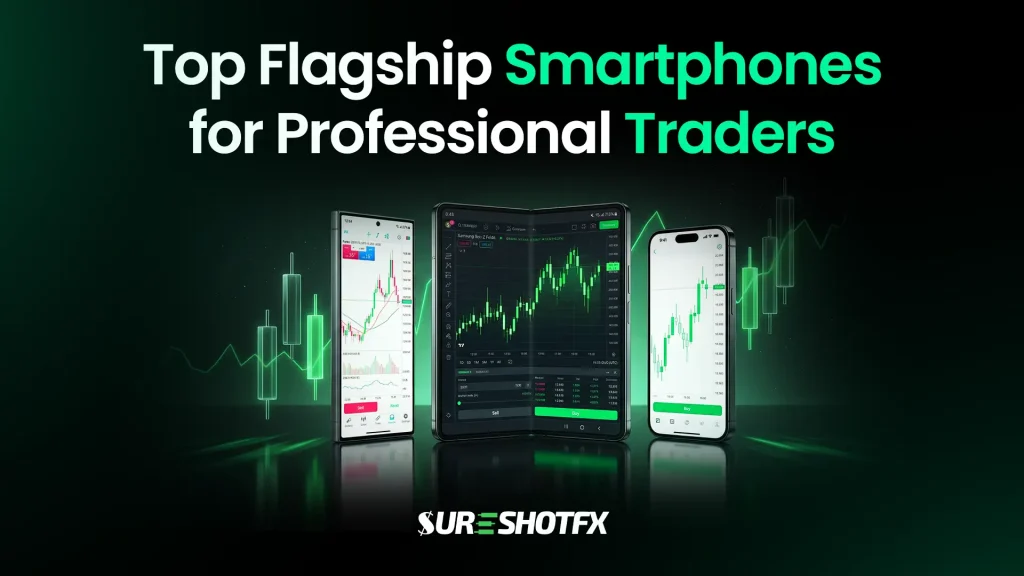
The following flagship smartphones stand out because their hardware aligns closely with the real demands of mobile forex trading in 2026.
Samsung Galaxy S25 Ultra
The Samsung Galaxy S25 Ultra is built like a surgical instrument for traders who value control and clarity.
Samsung Galaxy S25 Ultra Specifications
- Display: 6.9″ QHD+ Dynamic AMOLED
- Refresh Rate: 120Hz adaptive
- Processor: Snapdragon 8 Elite
- RAM: 12GB
- Battery: 5,000mAh
- Stylus: Integrated S Pen
AMOLED enhances chart clarity and color-coded indicator visibility. While the 200MP camera system is impressive, its real value to traders lies in document scanning, content creation, and record-keeping rather than photography.
What truly sets this device apart is the integrated S Pen. The S Pen enables precision chart drawing, making it easier to draw trend lines, adjust stop-loss levels, and interact with small on-screen controls without “fat-finger” errors.
In practical trading terms, this stylus transforms the phone from a touch device into a precision instrument.
iPhone 16 Pro Max
The iPhone 16 Pro Max represents stability, security, ecosystem efficiency and security is a defining strength of ios.
iPhone 16 Pro Max Specifications
- Display: 6.9″ Super Retina XDR OLED
- Chip: A18 Pro
- RAM: 8GB
- Refresh Rate: 120Hz ProMotion
- Biometric Security: Face ID
- Ecosystem Integration: Seamless integration with macOS
Powered by the A18 Pro chip and 8GB RAM, the device delivers exceptional single-core performance—an advantage for trading apps that rely on rapid sequential processing of price data and indicators.
Face ID biometric security protects trading accounts and supports two-factor authentication workflows without slowing access. The titanium frame improves durability, while battery life is among the strongest in Apple’s lineup, easily lasting all day under intensive trading use.
This makes the iPhone 16 Pro Max particularly compelling for professionals managing research, execution, and journaling across multiple screens.
Samsung Galaxy Z Fold 6
The Samsung Galaxy Z Fold 6 addresses one of mobile trading’s biggest limitations: screen size. The larger screen reduces execution errors on complex charts. AMOLED panels improve contrast and reduce eye strain.
Samsung Galaxy Z Fold 6 Specifications
- Outer Display: 6.3″ AMOLED
- Inner Display: 7.6″ AMOLED
- Refresh Rate: 120Hz (both displays)
- Processor: Snapdragon 8 Gen 3
- Multitasking: Supports split-screen trading
- Durability: IP48 water and dust resistance
Powered by the Snapdragon 8 Gen 3 processor, the Fold 6 delivers the raw performance required for CPU-intensive trading apps during high volatility. Multitasking support enables split-screen trading, allowing traders to view charts on one side while executing orders or monitoring news on the other.
Durability improvements such as a strengthened hinge and IP48 rating add confidence for daily professional use.
For serious traders, the right choice depends less on brand loyalty and more on how the device’s strengths align with execution style, risk management habits, and workflow demands.
Best Budget Smartphones for Traders
Reliable mobile forex trading does not require an ultra-premium flagship. In 2026, several budget and upper-midrange smartphones, under $500, deliver the processing power, AMOLED displays, and battery endurance needed for technical analysis and fast execution.
For traders focused on performance per dollar, these devices offer practical, dependable tools for navigating volatile markets without sacrificing core functionality.
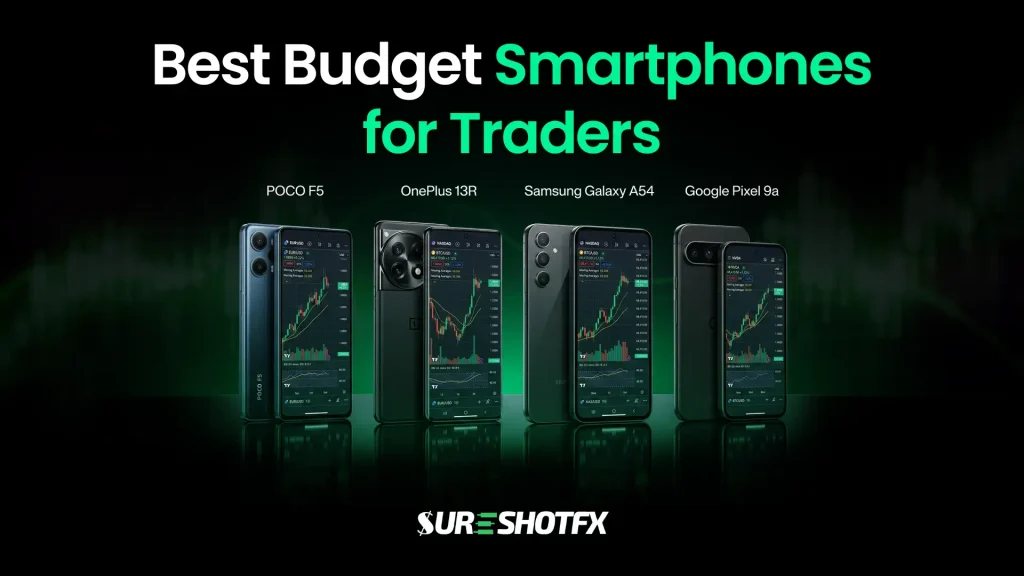
POCO F5
The POCO F5 is often labeled the best raw performance per dollar, and that reputation is well earned.
POCO F5 Specifications:
Display: 6.67″ AMOLED 120Hz
Chipset: Snapdragon 7+ Gen 2
RAM: 8GB / 12GB
Battery: 5,000mAh
Its Snapdragon 7+ Gen 2 chipset delivers near-flagship computing power, which is crucial for running indicator-heavy charts and executing trades quickly during volatility. The 120Hz AMOLED display ensures smooth chart movement, while the large battery supports long trading sessions without frequent recharging.
For traders who prioritize execution speed over brand prestige, this phone punches far above its price class.
OnePlus 13R
The OnePlus 13R offers flagship-level power in a more accessible price tier.
OnePlus 13R Specifications:
Display: 6.7″ AMOLED 120Hz
Chipset: Snapdragon 8 Gen 3
RAM: 8GB
Battery: 6,000mAh
Charging: 80W fast charging
The Snapdragon 8 Gen 3 processor performs excellently at heavy multitasking, making it suitable for traders who run charts, execution platforms, and news feeds simultaneously. Its massive 6,000mAh battery reduces anxiety during long market sessions, while 80W fast charging ensures minimal downtime.
This combination is ideal for traders who value speed, endurance, and uninterrupted workflow.
Samsung Galaxy A54
The Galaxy A54 stands out for reliability rather than raw speed.
Samsung Galaxy A54 Specifications:
Display: 6.4″ FHD+ AMOLED 120Hz
RAM: 8GB
Battery: 5,000mAh
Performance: Reliability Stable notifications
It handles system notifications consistently, which is critical for traders who depend on price alerts, stop-loss warnings, and margin notifications. The AMOLED display provides good clarity for chart analysis, and the balanced hardware ensures stable performance throughout the day.
For traders who value dependability and alert accuracy, this device offers peace of mind at a reasonable cost.
Google Pixel 9a
The Pixel 9a’s strength lies in software efficiency rather than hardware power.
Google Pixel 9a Specifications:
Display: 6.3″ pOLED 120Hz
Chipset: Tensor G4
RAM: 8GB
Battery: 5,100mAh
Advantage: Software Clean Android
Google Pixel 9a runs with minimal bloatware, which improves background app management. The clean android reduces background bloatware and improves app synchronization. This is especially valuable for traders who rely on real-time price updates and alerts.
While the Tensor G4 prioritizes AI and system optimization over raw benchmarks, the overall experience feels smooth and predictable—qualities that matter more than headline specs during live trading.
Final Verdict – Which Smartphone Should Forex Traders Choose?
There is no single “perfect” smartphone for every forex trader—and that is exactly the point. Traders should choose a smartphone based on budget, trading intensity, and reliability requirements, not the most expensive or heavily marketed mobile devices. Whether you choose a flagship, a foldable, or a well-balanced budget phone, what matters is that the device performs consistently under real market conditions.
The core objective is simple: to trade on the go without friction. A good trading smartphone should allow you to monitor markets, execute trades, manage risk, and stay disciplined—anywhere, anytime. If your phone lets you remain consistent, responsive, and focused without technical interruptions, then it is doing its job.
FAQs

Both iPhone and Android perform well; stability matters more than brand. Choose your system based on the ecosystem, update support, and budget.
No, 5G is not required for forex trading. Execution speed depends more on broker server proximity than mobile data type.
Network stability directly affects order execution speed and slippage. Bandwidth matters less than latency. A stable 4G connection often outperforms unstable 5G.
Yes, higher refresh rates improve visual smoothness. High refresh rates reduce eye strain during long sessions.
A good forex trading smartphone combines fast processing, sufficient RAM, a high-quality display, reliable battery life, and stable network connectivity.
Processor speed directly affects how quickly a trading app can process data and execution commands. Faster CPUs reduce execution delay, especially during high-volatility events.
Yes. Many modern budget and mid-range smartphones are fully capable of forex trading.
There is no single best smartphone for forex traders. The best option is one that fits your trading style, offers consistent performance, and remains reliable during volatile market conditions.