How to Control Emotions in Trading: Guide to FOMO, Greed & Emotionless Trading Strategy
Have you ever felt like holding a trade for a few more seconds might give you more profit, and then boom! The market pattern flips, and you lose your winning trade due to that greed for more profits.
This is why learning how to control emotions in trading is one of the hardest but must-have skills if you want profitable trading.
So, in this comprehensive guide, you will learn how to trade without emotion and build trading consistency.
Let’s dig in!

What is Emotional Trading?
Emotional trading is making trade decisions based on emotions instead of logical reasoning. In emotional trading, a trader makes decisions driven by fear of loss, greed for profit, excitement, stress, and overconfidence rather than analysis, logic, or predefined strategies.
Emotional trading mistakes occur when a trader executes a trade based on gut feelings or any other emotional biases rather than following the pre-defined trade plan.
Why Trading Emotions Matters?
Trading emotions highly matters because most traders lose money because of emotion, not because of the trading styles. And different research shows that this failure rate is around 90% just because people don’t know how to control trading emotions.
Trading is the only activity where your brain’s survival instincts work against you. So, when you can master this trading psychology and manage fear and greed, you can be a successful trader.
How Emotions Ruin Trading: Psychology Behind Fear, Greed & Impulsive Decisions
Emotions ruin trading by leading to impulsive trading decisions that override a trader’s logical analysis nd strategies. In the financial market, human emotions react proactively as they are related to money and your financial condition.
The rush to hold a trade when a trade goes in your favor, the panic when the charts become red, and you are about to lose, and the stubborn, illogical hope to see the movement bounce back. All these psychological facts are best known as trading psychology.
Excelling in trading requires mastering trading psychology. Emotional biases like the fear of losing or greed for more profits trigger the human brain and compel a trader to make trading decisions based on emotional biases.
When you can’t control your emotions in trading, you fail to take strategy-based trading decisions. As a result, you can not sustain for a long time in the market.
What are the Key Emotional Biases That Impact Trading Decisions?
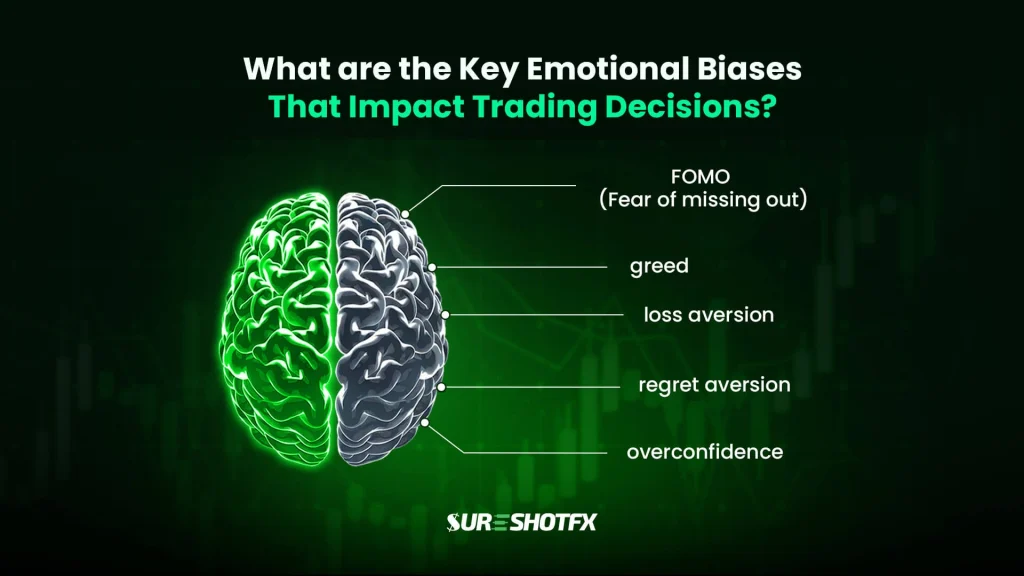
Fear, greed, and overconfidence are some prevalent emotional biases that directly impact trading decisions. Understanding how these work can help control trading emotions, resulting in disciplined trading.
FOMO (Fear of Missing Out), greed, loss aversion, regret aversion, and overconfidence are some common emotional biases.
A recent simulation study in July 2025 shows that emotional states, especially fear, anxiety, or frustration, heavily contribute to emotional biases like loss aversion, overconfidence, and availability bias, leading to impulsive decisions.
How Fear Impacts Trading Decisions?
Fear can make you open a trade too early or exit too late. While strategy says a trade should be placed at a specific entry but your fear of missing out on a big move, you place the trade too early, leading to losses.
This is also called FOMO trading. You go for a tiny profit target due to the fear of losing. But eventually, you miss bigger moves.
Another fear in trading is the fear of making the wrong move. To avoid the losses, you make small moves that eventually turn out to be a huge loss.
What is Overconfidence Bias in Trading?
Overconfidence in trading is a kind of cognitive bias. It provokes you to overtrade or trade without strategies just to prove the emotional intuitions and beliefs.
For example, the market is in a strong bullish trend. And one of your trades just hit the target TP (Take profit), and you are thinking, you can profit more. As a result, you fall for the trap of overconfidence trading.
What is Loss Aversion Trading Behaviour?
Loss aversion is the emotional trigger that fears losses and tries to avoid losses more than making gains. This is very dangerous behavioral finance.
To recover previous losses, traders hold on to a position for a longer time, with the hope that the market will return to the trader’s favor. A prospect theory for online financial trading shows that loss aversion has a significant contribution to financial trading decisions.
This emotional bias can be related to an employee who does not want to leave his job because of losing income, despite the toxic environment. The same happens in emotional trading where losses become a concern than profit.
How Availability Bias Works in Trading?
Availability bias is relying on a readily available occurrence instead of relying on historical and logical data. In this case, traders believe a random pattern change leading to profits unexpectedly might work later as well.
Despite verifying with historical trade data and logical analysis, traders’ mind believes current market events, which results in losses at last. This kind of emotional trading is also considered driven by confirmation bias.
How Anchoring Bias Influences Trading Decisions?
Anchoring bias works directly with trade entries. This emotional bias is kind of a psychological trap where traders heavily rely on making trade entries based on a subsequent entry rather than fundamental analysis.
Lack of experience and more emotional attachments cause this type of bias. Anchoring makes traders take impulsive decisions and miss profitable moves or hold on to losing positions.
What are the Effects of Emotional Trading Mistakes
Inconsistent behavior and poor trading decisions are some of the dangerous effects of emotional trading. Emotional trading leads a trader to make an entry delay for the greed of more profit, hold on a position without a logical reason for more profit gain, and miss opportunities due to chasing impulsive profit predictions.
Though there are several effects of emotions in trading, below are the most common and significant ones–
- Impulsive & poor Trading Decision: Emotions like fear and greed lead to impulsive trading decisions, causing huge losses instead of profit gain.
- Overtrading: Lack of experience and analysis can lead to overtrading and unusual losses.
- Revenge Trading: Negative feelings like panic, stress, and loss of aversion can make traders hold onto a losing position.
- Inconsistent Trading: Traders influenced by emotions lead to inconsistent trading patterns, which ultimately lower the success rate.
- Net Losses: Emotional trading causes losses after losses and increases the number the net losses among retail traders.
- Missed Opportunities: Emotional biases cause traders to place a trade either too late or too early, leading to missing profitable opportunities.
- Overconfidence: Several profitable trades can make a trader overconfident, which ultimately causes anchoring bias or availability bias. Overconfidence in trading causes excessive risk-taking tendency and inconsistent results.
- Increased Stress & Anxiety: Emotional trading neither brings profit nor mental peace. It causes anxiety and frustration due to not controlling emotions in trading.
How to Control Emotions in Trading?
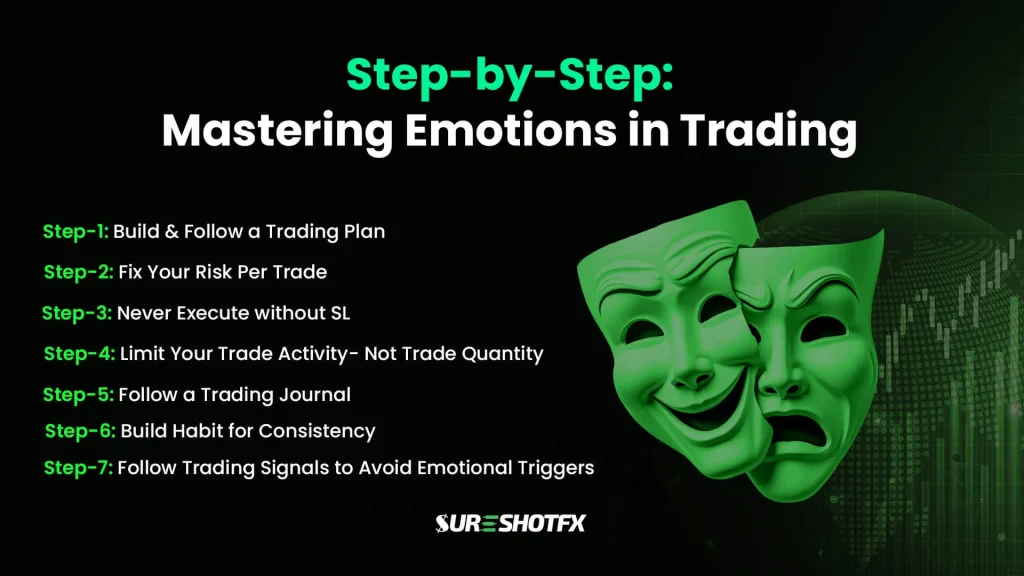
As a human being, you can’t remove emotions, but by building consistency and habitual trade behavior, you can control emotions in trading.
Let’s see how you can control emotions while trading and step by step remove emotion from trading.
Step-1: Build & Follow a Trading Plan
Build your own trading strategy based on different markets. Keep strict rules for entry and exit points and risk management strategies, like using a standard lot size and appropriate leverage for your account.
And just building the plan is not enough. You must stick to your trading plan no matter what your mind says.
Understand and accept that you will face losses. Losses are a part of trading, so there must be losses.
Step-2: Fix Your Risk Per Trade
One of the significant reasons why traders fail is a lack of proper risk management. Based on your capital account balance, fix your risk percentage for each trade. Set this as your must-follow rule.
Risking not more than 2% of the total account is recommended.
Setting a strong risk percentage for every trade helps maintain the risk tolerance level. It ultimately integrates both technical and emotional factors, leading to sustained trading success.
As a beginner, you might not feel the importance of fixing the risk percentage. During various market conditions- volatile and challenging, a strong risk parameter ensures a shield against emotional decisions.
For example, you can use a lot size calculator instead of manually calculating and setting your lot size to avoid the stress.
Step-3: Never Execute without SL
Set this in your mind that you can’t place a trade without setting SL (Stop-Loss). This is also a part of risk management strategies.
When you dare to execute a trade without an SL, your mind gets more emotional and tends to make impulsive decisions easily. Relying on mental Stop-Loss can be risky, and there is a high chance of the entire account blowing up.
Though trading without a stop-loss can be ideal for experienced professionals, beginners should not rely on this.
Step-4: Limit Your Trade Activity- Not Trade Quantity
Don’t trade continuously without any pause. This can cause mental pressure and impatience, resulting in emotional trade decisions more often.
Limiting your trade activity can help. For example, you can schedule your time for trading and when to take a break from the charts.
Set a daily target goal and number of trades. This will help in disciplined trading and maintain trade quality over quantity.
Step-5: Follow a Trading Journal
Follow a trading journal to reduce emotions. Maintaining a trade journal will help you understand and refine your trading strategies. It works like a strategy tester.
When you journal your trading, the reason and outcomes of each execution, along with the emotional trigger, after a time period, you will have potential insights into your trading to plan ahead.
Reviewing the journal time to time helps identify what emotional bias triggers you the most and what does not. And based on the journal, you can develop your own trading strategies.
Step-6: Build Habit for Consistency
Consistency is the key to disciplined and emotionless trading. You create a trading plan and your target goal, but you are not following them consistently, and your trading becomes inconsistent, leading to regrettable trades and losses.
Build your habit for consistency and trading without emotions. If you really want to become a successful trader, building a consistent and disciplined trading habit is essential.
Remember, building a habit only takes the courage to start and repeating the same practices every day.
Step-7: Follow Trading Signals to Avoid Emotional Triggers
One of the effective ways to control emotions while trading is to follow trade signals. It helps to avoid your mental stress of chart analysis and place trades without any emotional bias.
This really helps, especially in managing fear and greed in scalping. Again, controlling fear in day trading sometimes becomes quite challenging due to the rush for the daily target goal. But when you follow intraday signals, you can trade without emotional mistakes.
You don’t have to monitor the charts all day long, so no mental stress and no emotional bias. As a result, you can maintain consistency in trading.
Emotional Trading vs Systematic Trading (Which Wins and Why?)
Let’s face it- professionals use systematic trading and beginners use emotional trading. Here is a quick comparison-
| Factors | Emotional Trading | Systematic Trading |
|---|---|---|
| Consistency | Not Guaranteed | Guaranteed |
| Accuracy | Moderate to Lower | Higher |
| Stress Level | Higher | Lower |
| Profit | Moderate (Skill Dependent) | Stable Profit |
| Analysis | Highly Required | No Need |
So, it showcases how systematic trading, like using an Algo trading system, wins and largely helps to avoid emotional mistakes.
How to Recover After an Emotional Trading Loss?
Stopping your trading is the only way to recover after an emotional trading loss. As a human being, emotional biases occur, no matter how hard you try.
In case you incur a loss by emotional trading mistakes-
- Stop your trading right after an emotional major loss.
- Review your journal and analyse which emotional bias triggers that mistake.
- Review your trading plan with logic, not regret.
- Restart trading with more risk management options.
- Avoid emotional triggers to recover the losses.
Final Words
Trading without emotions does not mean being robotic. It’s about being consistent and disciplined in trading for long-term trading success. The market does not bother about your profit or loss or account blowup.
So, the ultimate trading success depends on disciplined trading, trading without any impact of emotional bias. Follow the trading plan and review your trading weekly or monthly to define and set your own trading strategy.
However, if you want to avoid emotional biases in trading, try SureShotFX- accurate and transparent trade signals on the Telegram channel, built for every trader- from beginner to advanced.
Contact us to learn more, as the SureShotFX support team is available 24/7 at your service.
FAQs
Almost. Success in trading depends on around 60-70% of psychology, no matter the trader’s level.
Typically, it is not a high-stress job as long as you follow a trading plan and stick to that.
The 2% rule in trading is not to risk more than 2% of your total capital account.
No. As a human being, traders can never eliminate emotions, but by maintaining a disciplined trading practice, one can avoid emotions while trading and reduce emotional mistakes.