What is a Lot Size in Forex? How to Calculate Lot Value and Manage Risk Accurately?
Lot size is one of the most fundamental yet misunderstood concepts in trading. Whether you trade Forex, gold, crypto, or indices, the size of your lot determines your risk, your pip value, and ultimately your long-term profitability. If your lot size is even slightly off, you can ruin a perfectly good strategy.
In Forex trading, the term “lot” plays a central role in defining how much of a currency you’re buying or selling. Without understanding what a lot of trading means, you can’t properly manage risk, calculate trade size, or develop a consistent strategy.
Lot sizes influence everything, from trading volume and pip value to margin and leverage requirements. Whether you’re trading currencies, indices, gold, crypto, or commodities, knowing the right lot size helps you protect your capital and trade smarter. Mastering it is non-negotiable.

What is a Lot Size in Forex Trading?
A lot is the standardized trading unit used to measure the volume of a trade. In Forex, one standard lot equals 100,000 units of the base currency. In simple terms, it represents the amount of currency being bought or sold in a single trade. Because currencies move in tiny increments (pips), lot size helps scale those movements into meaningful profit or loss.
In Forex, the standardized unit is what allows brokers to maintain uniform pricing, liquidity, and execution. Choosing the right lot size for trading is crucial because it controls your exposure and determines how much a pip is worth.
The Lot Size as a Standardized “Egg Cartons”
Many beginners struggle with the concept of a lot—so here’s an analogy:
Think of Lot Size like an egg carton.
Just as a carton neatly groups eggs in a fixed quantity, a lot groups units of currency in a structured amount. You don’t buy individual eggs from a farm; you buy cartons. Likewise, you don’t buy random amounts of currency—you buy predefined lots.
A forex lot behaves just like that carton, but instead of eggs, it packages currency units. A standard lot is 100,000 units, a mini is 10,000, and a micro is 1,000. You’re not picking up “3,742 euros” the way you might pluck loose eggs from a basket.
You take a complete “carton” of currency, because markets operate smoothly only when everyone trades in consistent, agreed-upon packages.
Example:
Suppose you’re buying EUR/USD. If the market let you trade any arbitrary amount—€912, €6,433, €87.5—it would be complete chaos. Spreads would vary wildly, liquidity would splinter, and price quotes would become unpredictable.
This is where the lot comes in — the universal “carton” of trading. Pick a mini lot, and you instantly know the price movement of every pip and the risk behind it.
Just like grabbing a six-egg carton 🍳 ensures you know exactly how much omelet you can make, using standardized lots keeps your trading predictable and organized.
What are the Different Types of Lot sizes?
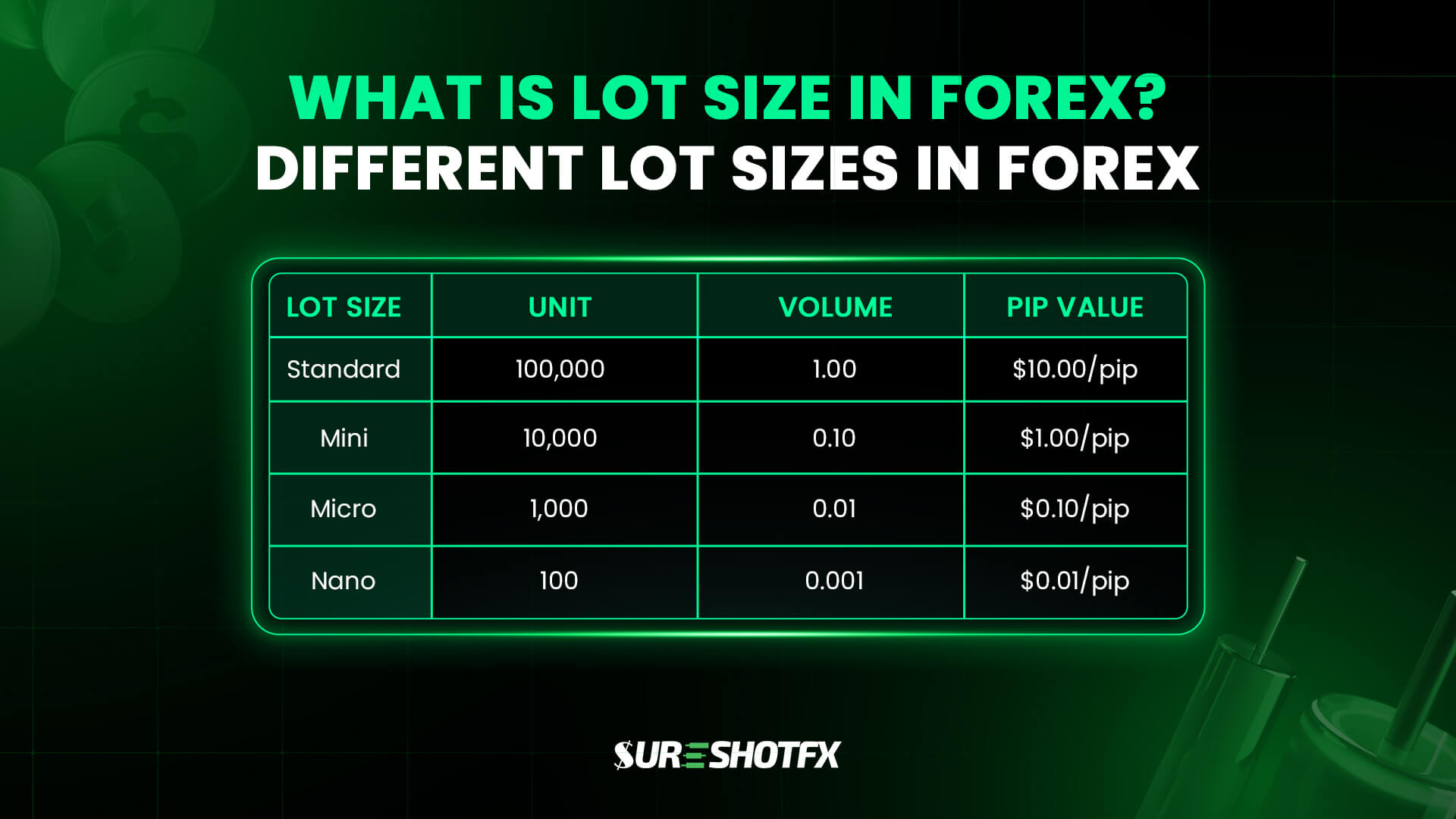
Forex traders can choose between four main lot sizes depending on risk tolerance, account size, and experience:
| Lot Size | Units | Pip Value |
|---|---|---|
| Standard | 100,000 units | ≈ $10 per pip |
| Mini | 10,000 units | ≈ $1 per pip |
| Micro | 1,000 units | ≈ $0.10 per pip |
| Nano | 100 units | ≈ $0.01 per pip |
Different brokers provide these options to suit various account sizes and trading styles. If you’re a new trader wondering, “What is the best lot size for beginners in forex?”— As the lot size decreases, the pip value and risk also decrease. A micro or nano lot is the safest starting point for new traders learning proper risk control.
What is a standard lot size in forex?
A standard lot in forex is a trade size of 100,000 units of the base currency. This is the benchmark position size used by professional traders and institutions. A standard lot typically produces a pip value of about $10 on USD-quoted pairs.
Example: If you buy 1 standard lot of EUR/USD, you’re essentially buying 100,000 euros. A 10-pip move in your favor earns about $100, and a 10-pip loss costs the same. |
What is a mini lot size in forex?
A mini lot is 10,000 units of the base currency. It’s one-tenth the size of a standard lot and is often the stepping stone for traders moving up from smaller accounts. A mini lot has a pip value of about $1.
Example: Buying 1 mini lot of GBP/USD means you’re trading 10,000 British pounds. A 15-pip move results in a gain or loss of roughly $15. |
What is a micro lot in forex?
A micro lot is 1,000 units of the base currency. This small position size is ideal for beginners or precise risk management. Its pip value is about $0.10, allowing traders to practice without heavy exposure.
Example: If you open 1 micro lot of USD/JPY, you’re trading 1,000 U.S. dollars worth of yen. A 20-pip move changes your P/L by only $2. |
What is a nano lot in forex?
A nano lot is 100 units of the base currency. It’s the smallest possible trade size and carries a pip value of about $0.01, making it useful for ultra-low-risk testing and learning.
Example: Buying 1 nano lot of EUR/USD means you’re trading 100 euros. A 30-pip move affects your balance by just $0.30. |
Why Does Lot Size Matter in Forex?

Lot size is one of the biggest factors that dictates:
- how much money you risk per trade
- how margin is used
- how your account grows (or shrinks)
- how leverage amplifies your exposure
Trade too big, and even small price movements can destroy your account. Trade too small, and your wins may not be meaningful. Understanding this balance is key to sustainable Forex performance.
What is the Relationship between Lot Sizes and Pip Values?
The relationship between lot sizes and pip values is simple: the bigger the lot size, the bigger the pip value, and the smaller the lot size, the smaller the pip value. Pip value scales directly with the number of currency units you’re trading, which means your profit or loss per pip moves in proportion to your position size.
This relationship is the foundation of smart position sizing, because knowing how pip value changes with lot size lets you calculate risk long before you hit the “Buy” or “Sell” button.
How Lot Size Directly Impacts Risk, Leverage & Margin?
When trading forex, understanding lot sizes is critical because the size of your trade directly influences your risk exposure, leverage usage, and margin requirements. Each lot type—standard, mini, micro, or nano—affects how much you can gain or lose on each pip movement.
Lot Size and Risk Exposure
Lot size determines the monetary value of each pip, meaning larger lots carry higher potential profits but also higher potential losses.
- Standard Lot (100,000 units): Each pip movement ≈ $10. A 50-pip adverse move could cost $500.
- Mini Lot (10,000 units): Each pip movement ≈ $1. A 50-pip move = $50.
- Micro Lot (1,000 units): Each pip movement ≈ $0.10. A 50-pip move = $5.
- Nano Lot (100 units): Each pip movement ≈ $0.01. A 50-pip move = $0.50.
Example: If you trade 1 standard lot of EUR/USD and the price drops by 50 pips, your loss is $500. By contrast, trading 1 micro lot for the same movement only risks $5. This shows how choosing the right lot size aligns with your risk tolerance. |
Lot Size and Leverage
Leverage allows traders to control larger positions with a smaller account balance. However, the larger your lot, the more leverage you effectively use, which increases both risk and potential reward.
- A larger lot consumes more of your available leverage.
- Using a small lot allows you to maintain lower leverage exposure, reducing the chance of a margin call.
Example: Suppose your account has $1,000 and your broker offers 1:100 leverage. Opening a standard lot (100,000 units) will require $1,000 in margin. Trading a mini lot would only require $100, letting you manage multiple trades simultaneously without over-leveraging. |
Lot Size and Margin Requirements
Margin is the amount of money required in your account to open a position. The larger the lot, the higher the margin needed.
- Standard Lot: High margin requirement, higher risk.
- Mini Lot: Moderate margin, suitable for medium accounts.
- Micro/Nano Lot: Low margin, ideal for beginners and small accounts.
Example: If you want to trade 1 standard lot of GBP/USD with 1:50 leverage, you need $2,000 margin. Trading 1 micro lot would require only $20. By adjusting lot size, you control how much capital is at stake per trade, which is a cornerstone of sound risk management. |
How to Calculate Lot Size in Forex?
Calculating lot size is one of the most important skills in forex trading. Lot size determines how much currency you buy or sell, which directly affects your risk exposure, potential profits, and margin requirements. Understanding the calculation helps traders manage risk efficiently and trade with confidence.
Key Components for Calculating Lot Size:
- Account Balance: The total capital in your trading account.
- Risk Percentage: The portion of your account you’re willing to risk per trade (usually 1–3%).
- Stop-Loss Distance: The number of pips between your entry price and stop-loss.
- Pip Value: Monetary value per pip, based on the lot size and currency pair.
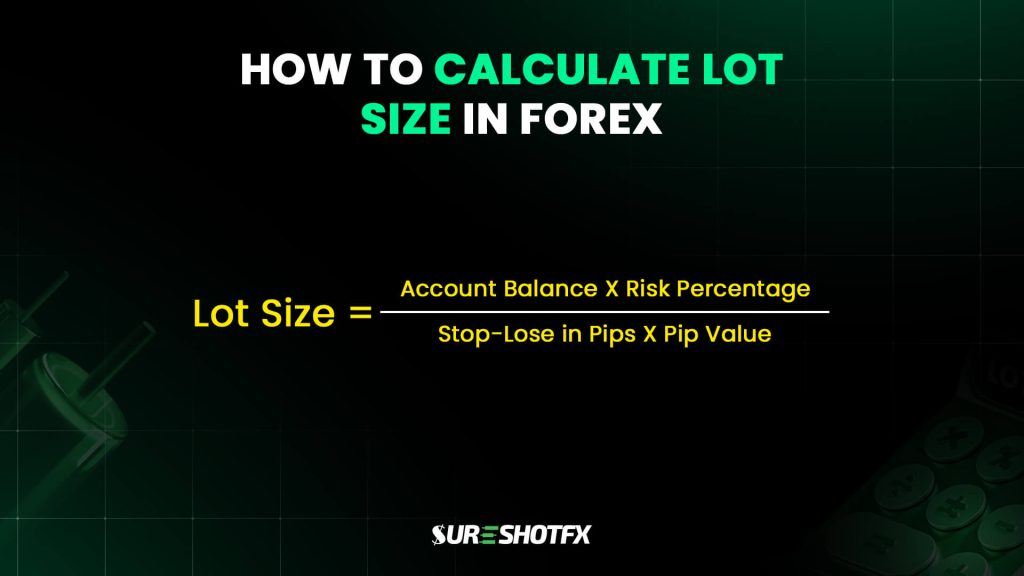
Lot Size Calculation Formula
Lot Size Formula: (Account Balance × Risk Percentage) ÷ (Stop-Loss in Pips × Pip Value) |
Step-by-Step Example:
- Account Balance: $5,000
- Risk: 2% per trade → $5,000 × 2% = $100
- Stop-Loss: 50 pips
- Trading Pair: EUR/USD (pip value for 1 mini lot = $1)
This means you can safely trade 2 mini lots without risking more than 2% of your account.
Adjusting for Different Lot Types
- Standard Lot: Multiply by $10 per pip
- Mini Lot: Multiply by $1 per pip
- Micro Lot: Multiply by $0.10 per pip
- Nano Lot: Multiply by $0.01 per pip
Example: If you want to risk $50 with a 25-pip stop-loss: Standard Lot: $50 ÷ (25 × 10) = 0.2 standard lot Mini Lot: $50 ÷ (25 × 1) = 2 mini lots Micro Lot: $50 ÷ (25 × 0.1) = 20 micro lots |
How to Choose the Right Lot Size for Your Trading Strategy?
Different strategies demand different lot sizes. Scalping needs small lots because stop losses are tight and volatility creates frequent noise. Swing traders typically use slightly larger lots since trades last longer and targets are wider. Gold and crypto require even more conservative lots due to sharp movements.
Selecting the right lot size is one of the most important decisions a forex trader can make. Your lot size affects risk exposure, potential profits, and emotional stability during trades. Choosing incorrectly can lead to unnecessary losses or missed opportunities, while the right choice can enhance consistency and confidence.
1. Understand Your Trading Style
Different trading styles require different lot sizes because they involve varying trade frequency, stop-loss levels, and risk tolerance:
Scalpers: Execute multiple trades per day with small price movements. Recommended Lot: Micro or Nano lots Day Traders: Hold positions for several hours, often closing by the end of the day. Recommended Lot: Mini lots or small standard lots Swing Traders: Hold positions for days to weeks to capture larger market moves. Recommended Lot: Mini or Standard lots depending on account size Position Traders: Hold trades for weeks or months, focusing on long-term trends. Recommended Lot: Standard lots (for experienced traders with large accounts) |
2. Match Lot Size With Risk Tolerance
Even within the same trading style, your risk appetite should guide lot size decisions:
- Low Risk: Micro or Nano lots (suitable for beginners or small accounts)
- Moderate Risk: Mini lots (for consistent traders with moderate capital)
- High Risk: Standard lots (for experienced traders with large accounts)
3. Consider Account Size and Leverage
Your account balance and leverage limit how large your positions can safely be:
- Small account + high leverage → only small lots are safe to avoid margin calls.
- Large account + low leverage → you can safely trade larger lots while maintaining risk management.
4. Adjust Lot Size Based on Market Volatility
Highly volatile markets require smaller lots to reduce the risk of sudden adverse price moves, while stable markets may allow slightly larger positions.
💡Pro Tip: Many successful traders use lot size calculators to determine the optimal position for each trade, combining account balance, stop-loss, and desired risk percentage. This removes emotional guesswork and improves consistency.
Beyond Currency: Lot Size in Stocks and Commodities
When most traders hear the term lot size, they immediately think of forex. However, lot size is a crucial concept that extends beyond currency trading and applies to stocks, commodities, and other financial markets. Understanding how lot size works across these assets helps traders manage risk, leverage, and capital efficiently, no matter what market they are in.
In the stock market, a lot represents the number of shares bought or sold in a single transaction. The most common type is the standard lot, which typically consists of 100 shares, also known as a “round lot.” Some brokers also allow fractional shares, which function as mini lots, giving traders with smaller accounts the ability to participate without committing significant capital.
Lot sizes play an equally important role in commodities trading. Here, the lot size defines the quantity of the underlying asset you control and varies depending on the commodity and exchange. For instance, one standard lot of gold typically represents 100 troy ounces.
Crude oil standard lots often represent 1,000 barrels, while silver contracts may cover 5,000 troy ounces. Because commodity contracts are usually large, managing risk and margin is critical. Many brokers offer mini or smaller contracts for traders who wish to reduce exposure, especially during volatile market periods.
Lot size is a concept that transcends forex trading. Whether trading stocks or commodities, the size of your position determines your risk, potential profit, and capital efficiency.
What are the Common Lot Size Mistakes Traders Make?
Lot size is a fundamental concept in trading, yet many traders—especially beginners—make critical mistakes that can lead to unnecessary losses, emotional stress, and account depletion. Understanding these common errors can help traders manage risk more effectively and trade with greater consistency.
Here are frequent mistakes:
- Overleveraging: Using big lots without understanding margin leads to margin calls.
- Inconsistent Lot Sizes: Switching randomly between lots causes unpredictable risk.
- Emotional Trading Volume: Winning traders risk based on data, losers risk based on emotion.
- Ignoring Pip Value: Many traders don’t calculate pip value, leading to oversized losses.
How to Avoid Lot Size Mistakes In Forex Trading?
Lot size is a critical factor in trading success. Choosing the wrong lot size can lead to excessive losses, stress, and account depletion, while the right lot size helps manage risk and grow your capital consistently.
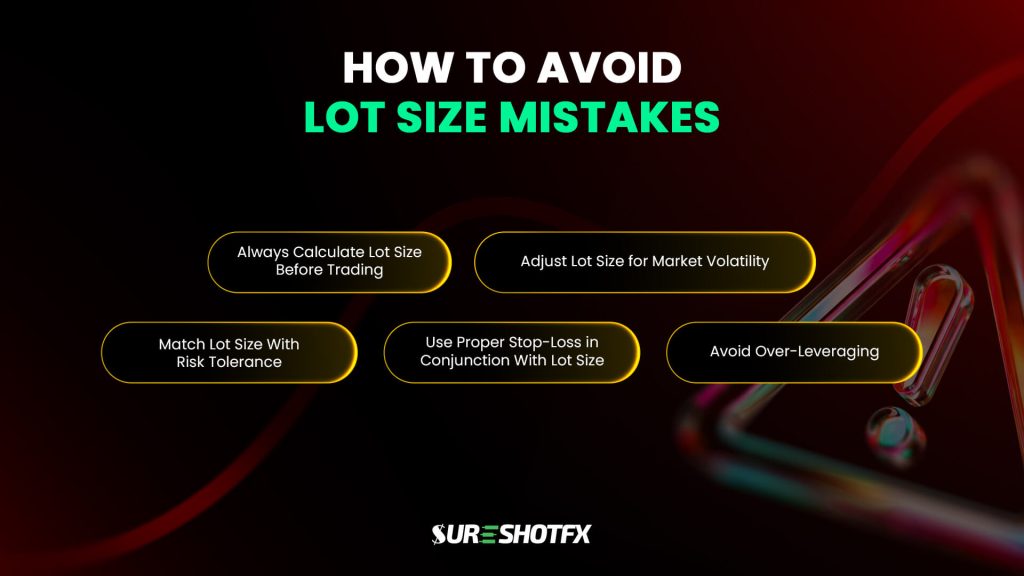
Here’s how traders can avoid common lot size mistakes and trade more safely.
- Always Calculate Lot Size Before Trading
The first step in avoiding lot size mistakes is to calculate the optimal lot size for each trade based on your account balance, risk tolerance, and stop-loss distance. - Match Lot Size With Risk Tolerance
Traders often make the mistake of trading large lots without considering their emotional and financial risk tolerance. Choosing a lot size too big for your comfort level can lead to panic, premature exits, or impulsive decisions. - Adjust Lot Size for Market Volatility
Market volatility affects the potential range of price movement. Trading the same lot size in calm and volatile conditions can create unnecessary risk. - Use Proper Stop-Loss in Conjunction With Lot Size
Lot size and stop-loss distance go hand in hand. Failing to consider stop-loss when selecting lot size can expose your account to disproportionate losses. - Avoid Over-Leveraging
Using leverage to open large positions without adjusting lot size is a common mistake. High leverage magnifies both profits and losses.
Why Should You Use a Lot Size Calculator?
In trading, selecting the wrong lot size is one of the most common mistakes that can quickly deplete an account, even for experienced traders. A lot size calculator is an essential tool that helps traders determine the optimal position for each trade, ensuring proper risk management and increasing the likelihood of long-term success.
One of the primary advantages of using a lot size calculator is that it allows for accurate risk management. By entering key information such as your account balance, the percentage of your account you are willing to risk per trade, the stop-loss distance in pips, and the currency pair, the calculator instantly provides the ideal lot size.
In addition to accuracy, a lot size calculator saves time and reduces human error. Manually calculating lot sizes for multiple trades or different currency pairs can be tedious and prone to mistakes. Automation allows traders to focus on strategy and market analysis rather than tedious calculations.
Professional traders rely on calculators to eliminate human error. They ensure consistency and protect accounts from emotional decisions. You can use any reputable tool, and SureshotFX Lot Calculator is a solid option for fast, accurate lot calculations.
The SureShotFX Forex Lot Size Calculator is user-friendly and simple to use. Making it suited for traders of all levels of experience. It makes complex calculations easier to understand. And ensures that traders can simply identify the right lot size for their trades.
Conclusion
Mastering lot sizes is one of the most important skills in Forex trading. By understanding how lots impact pip values, margin use, and overall risk exposure, you can create a consistent, data-driven strategy. Choosing the right lot size strategy protects your capital and helps ensure long-term profitability. The key is simple: trade with structure, use proper calculations, and never let emotions dictate your position sizing.

In forex trading, XAUUSD (Gold vs. US Dollar) uses a standard lot of 100 ounces of gold. This means 1 standard lot equals 100 oz, and the value of each pip depends on the lot size and market price.
Lot Size = (Account Balance × Risk %) ÷ (Stop-Loss Pips × Pip Value)
The smallest lot size is usually a nano lot (0.01 lot), equivalent to 100 units of the base currency. Nano lots are ideal for beginners or for testing strategies with minimal risk.
Beginners should use micro lots (0.01) or nano lots (0.001) to keep risk small and manageable.
When scalping, use smaller lots – Typically 0.01 to 0.05 lot to reduce risk from frequent trades.
Yes. One standard lot exposes small accounts to extremely high pip value and volatility, making it unsafe for most traders.