

EURUSD Forecast: Euro Steadies Near 1.12 as French Debt and Fed, ECB Decisions Ahead


- EUR/USD closed the week at 1.12031, down 0.32%
- The euro remains under pressure from French debt concerns and rising energy prices
- The Federal Reserve (Fed) and European Central Bank (ECB) announce their rate decisions on 28 and 29 October, respectively.
Why Is EUR/USD Under Pressure?
The EUR/USD pair holds steady near 1.12 as traders prepare for two major central bank decisions this week. Concerns over French government debt, higher energy prices, and uncertainty about interest rates are weighing on the euro.
The pair closed last week at 1.12031 after moving between 1.11803 and 1.12607. Trading reopened on Sunday evening (US time) near 1.1220, dipped to 1.1202, and recovered to around 1.1221 early on 26 October.
French Debt Concerns Weigh on the Euro
French government bond yields have risen as investors assess the country's fiscal outlook. The 10-year French bond yield reached 5.14% on 22 October before ending the week at 5.04%, according to MUFG data cited by Capital Street FX.
Higher bond yields can increase government borrowing costs and reflect growing concerns about fiscal risks. These concerns may also weaken investor confidence in the euro.
Economic data has added to the pressure. The eurozone composite Purchasing Managers' Index (PMI), which measures business activity, slipped to 51.9. France's reading fell to 48.4, indicating contraction in private-sector activity.
Higher Energy Prices Add to Inflation Risks
Energy prices are another factor to watch. According to VT Markets, tensions around the Strait of Hormuz and the ongoing Russia-Ukraine war are contributing to concerns about energy supply and inflation.
Higher oil and gas prices can increase transportation and production costs. If these pressures keep inflation elevated, central banks may have less room to cut interest rates.
For EUR/USD, the impact will depend on how energy prices affect the eurozone economy and how the Fed responds to inflation in the United States.
Fed and ECB Decisions Take Centre Stage
The Fed announces its interest rate decision on Wednesday, 28 October, at 2:00 pm ET, followed by the ECB on Thursday, 29 October. Both central banks are widely expected to keep rates unchanged, according to the cited market reports.
However, their forward guidance could drive the next major move in EUR/USD.
The Fed's target rate currently stands at 3.75%–4.00%, while the ECB's deposit rate is 2.50%. Traders will focus on whether policymakers signal further tightening or suggest that rates are likely to remain unchanged.
US third-quarter GDP and core Personal Consumption Expenditures (PCE) inflation data, due on 29 October at 8:30 am ET, will also be important. Stronger-than-expected figures could reinforce expectations of another Fed rate hike, potentially supporting the US dollar.
Morgan Stanley analysts cited by MarketScreener see December as a more natural time for a potential ECB policy change. This leaves traders watching both the immediate rate decisions and any clues about what comes next.
EUR/USD Technical Outlook: Key Levels to Watch
On the daily chart, the pair trades well below its 200-day moving average at 1.1571. Since setting a 2026 low of 1.1113 on 14 October, it has moved sideways between 1.1180 and 1.1260.
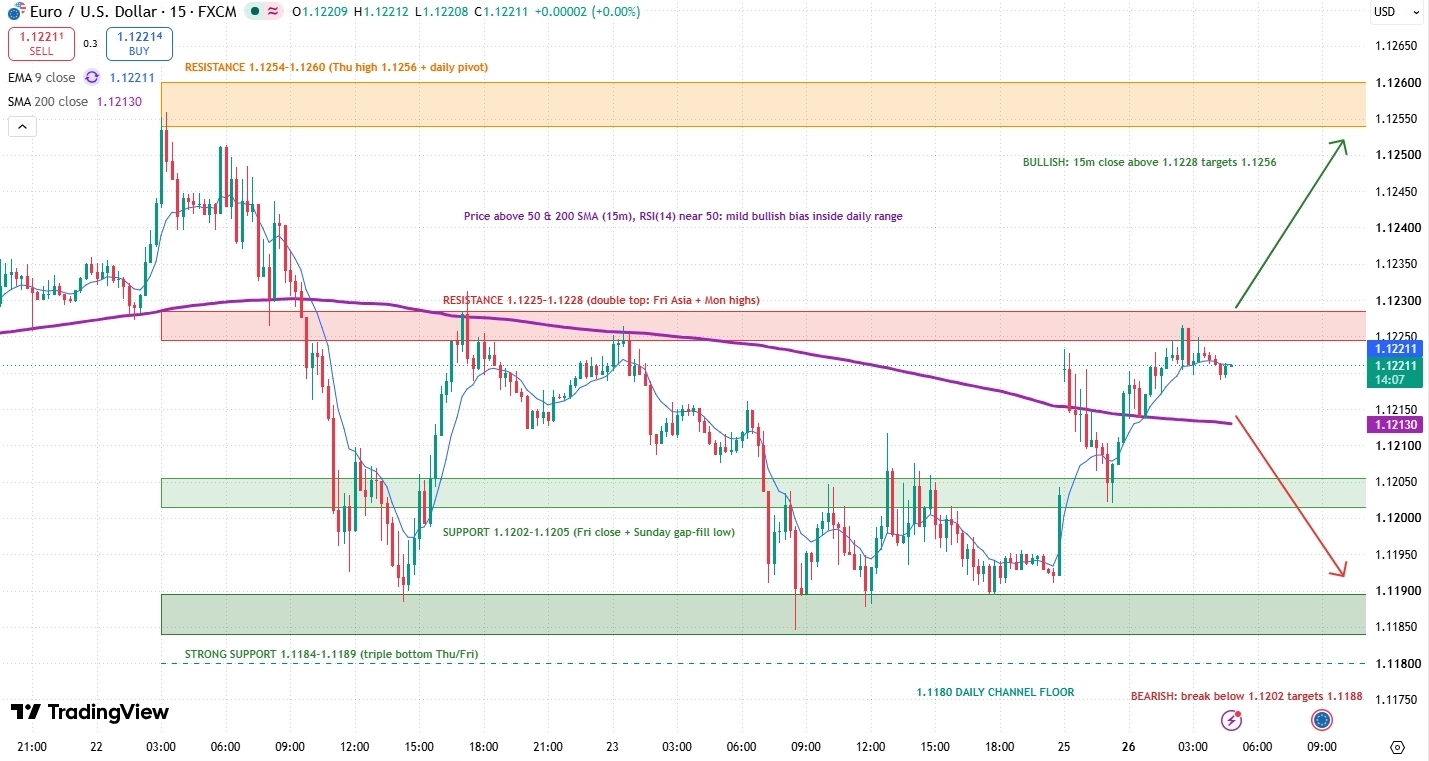
Key resistance levels: 1.1260, 1.1355, and 1.1379.
Key support levels: 1.1180, 1.1113, 1.1105, and 1.1000.
The 1.1260 level is the first resistance to watch after last week's failed recovery. A daily close above it could open the way toward 1.1355, followed by the 100-week moving average near 1.1379.
On the downside, 1.1180 is an important support level. Capital Street FX notes that a weekly close below this area could extend the decline. Further support lies at the 2026 low of 1.1113 and the 200-week moving average at 1.1105.
If selling pressure continues, the psychological 1.1000 level could become a longer-term downside focus.
What Should Traders Watch This Week?
Several events could influence EUR/USD during the final week of October.
- German Ifo Business Climate (26 October): The survey measures business sentiment among German companies. Stronger-than-expected results could support the euro, while weaker readings may add to concerns about economic growth.
- Fed interest rate decision (28 October): Traders will focus on the rate announcement and the press conference for clues about future policy. A more hawkish tone could support the US dollar.
- ECB interest rate decision (29 October): Any change in the ECB's assessment of inflation and economic growth could influence the euro.
- US GDP and core PCE data (29 October): Stronger economic growth or persistent inflation could increase expectations of further Fed tightening, putting additional pressure on EUR/USD.
- French bond yields and energy prices: Rising yields or renewed energy supply concerns could weigh on the euro, particularly if they increase uncertainty about the eurozone's economic outlook.