Nasdaq Sell-Off: Can Nvidia Earnings Trigger a Tech Stock Recovery?

- Nasdaq Composite fell 0.74% for a fourth straight losing session.
- Nvidia reported record revenue of $115.8 billion, beating forecasts.
- Concerns over artificial intelligence (AI) spending and Nvidia's outlook weighed heavily on tech stocks.
- Traders price in about a 96% chance of a December Fed hike.
Why is Nasdaq Selling Off Today?
Concerns over AI spending, weakness in major technology stocks, and expectations of further Federal Reserve interest rate hikes are driving the Nasdaq sell-off.
However, Nvidia's latest earnings report could provide support for a short-term recovery in technology stocks.
Nvidia Earnings Beat Estimates: Is the AI Sell-Off Losing Momentum?
Nvidia's latest earnings offered some relief to investors concerned about slowing AI demand.
On November 17, Nvidia reported third-quarter fiscal 2027 revenue of $115.8 billion, up 103% year over year. Data center revenue reached $107.6 billion, increasing 110%.
Adjusted earnings per share (EPS) came in at $2.68, while the company forecast fourth-quarter revenue of approximately $130 billion, above the $125.1 billion analyst estimate.
Despite the strong results, investors remain concerned about whether massive AI investments can generate enough long-term returns.
The initial market reaction was positive. Nasdaq 100 futures gained approximately 1.5% in early Asian trading on November 18, while Nvidia shares rose more than 5% in extended trading. On November 17, 2026, CFO and interim CEO Colette Kress told investors,
“Our ambition will not change, our passion to innovate will not change, and our commitment to customers, partners, and shareholders will not change.”
However, this recovery does not yet confirm that the broader Nasdaq downtrend has ended.
Federal Reserve Rate Hike Fears Continue to Pressure Technology Stocks
Federal Reserve interest rate expectations remain another major concern for the Nasdaq.
Higher interest rates increase borrowing costs and reduce the value of future corporate earnings, making growth-oriented technology stocks less attractive to investors.
The Fed maintained its federal funds target range at 3.75%–4.00% following its October 27–28 meeting. Its next policy meeting is scheduled for December 8–9, 2026.
Market pricing on November 17 suggested approximately a 96% probability of a 25-basis-point rate increase in December. A London-based economist, Henry Russell, commented,
"Overall, the report reinforces our view that further interest rate hikes from the Fed are warranted in order to counter demand-pull inflation."
Higher Treasury yields have also added pressure to technology stock valuations, increasing uncertainty across the US stock market.
Nasdaq 100 Technical Analysis: What Does the Nasdaq Chart Show?
The Nasdaq 100 remains under bearish pressure despite the positive reaction to Nvidia's earnings.
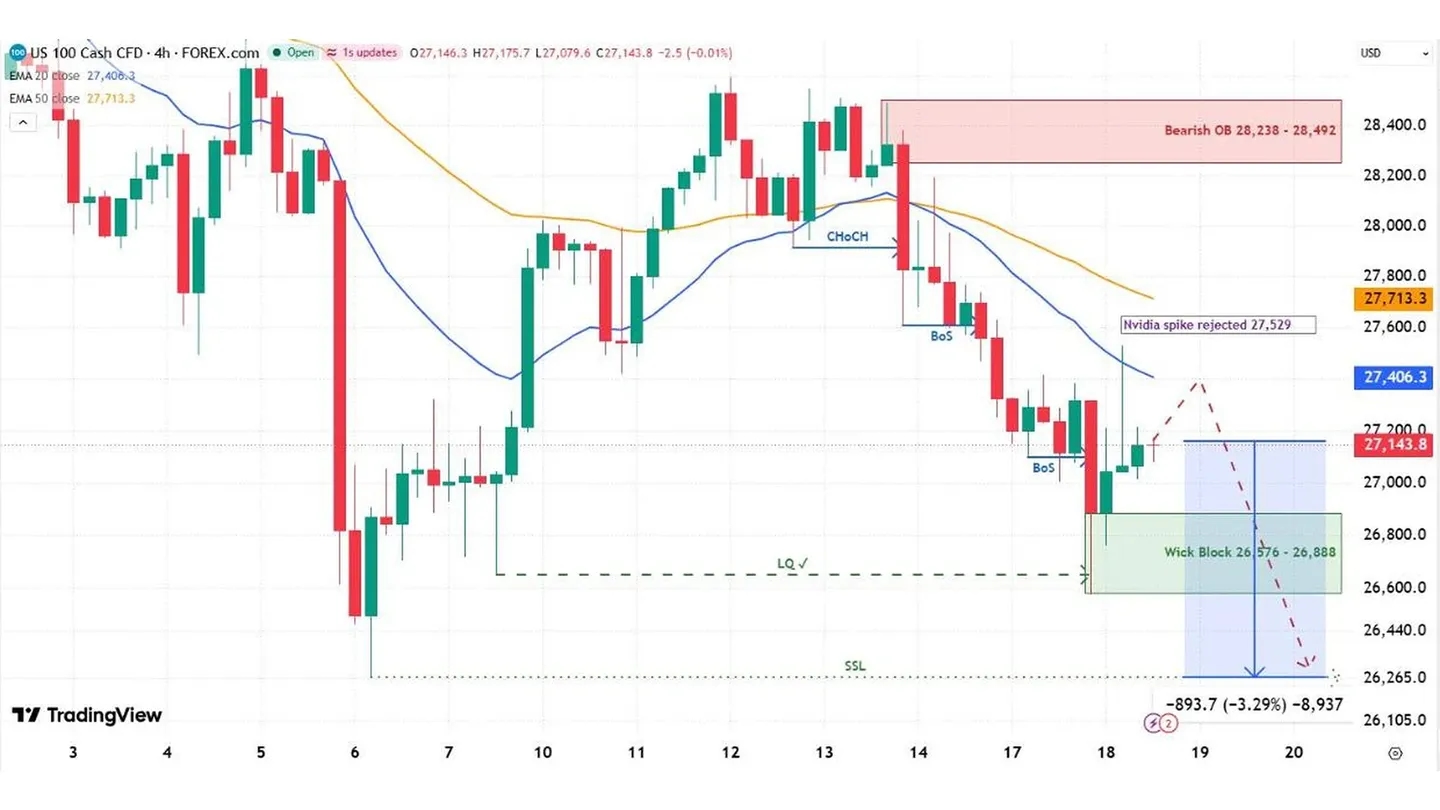
The 4-hour chart shows sellers in control. A CHoCH below 27,913 on November 13, then BoS breaks below 27,609 on November 16 and 27,099 on November 17, confirmed the downtrend. On Tuesday, a liquidity sweep to 26,576 left a wick block at 26,576 to 26,888. Nvidia’s spike to 27,529 was then rejected below the 27,609 BoS level.
Resistance: 27,529, 27,609, 28,238 to 28,492 (bearish order block)
Support: 27,000, 26,576 to 26,888 (wick block), 26,266 (November low)
The technical summary also showed a strong sell signal, with 10 moving-average sell signals and eight bearish technical indicators.
Nasdaq 100 Forecast: Will Nasdaq Go Up or Down After Nvidia Earnings?
The Nasdaq 100 forecast depends on whether Nvidia's earnings can bring buyers back into the technology sector.
Bullish Scenario: Can Nvidia Trigger a Nasdaq Recovery?
If buyers defend 27,000, the index could recover toward 27,550 and the 50-day EMA near 27,713.
A breakout above this resistance could open the way toward 28,100 and 28,650.
Bearish Scenario: Will the Nasdaq 100 Fall Below 27,000?
If selling pressure returns, a break below 27,000 could expose the November low near 26,450.
Further losses could bring 26,000 and 25,000 into focus.
Renewed AI spending concerns or hawkish Fed signals could accelerate the decline.
Overall outlook: The Nasdaq 100 keeps a bearish bias below its 4-hour 20 and 50 EMAs. A recovery above 27,609 would improve the bullish outlook, while a break below 26,576 would strengthen the bearish case.
Economic Events to Watch for Nasdaq This Week
| Event | Date and time (ET) | Potential Market Impact |
|---|---|---|
| FOMC minutes | Nov 18, 2:00 PM | Interest rate expectations |
| US initial jobless claims | Nov 19, 8:30 AM | Economic outlook |
| Anthropic IPO debut | Nov 19 | AI investment sentiment |
What Should Traders Do During the Nasdaq Tech Sell-Off?
The Nasdaq sell-off could create trading opportunities, but elevated volatility requires careful risk management.
- Watch 27,000 support: A break below it could expose 26,450.
- Monitor Nvidia: Continued gains in semiconductor stocks could support a recovery.
- Follow FOMC minutes: Hawkish signals could increase selling pressure.
- Wait for confirmation: Look for a bullish reversal or resistance breakout before considering long positions.
- Manage risk: Use appropriate stop-loss levels and smaller position sizes during volatile conditions.
FAQs
Should I Buy Nvidia Stock Now?
You can, if you are an expert index trader or portfolio manager. Nvidia's strong earnings and positive revenue outlook could support further gains. However, investors should consider the stock's valuation, market volatility, and broader AI investment concerns before buying.
Will Nvidia Stock Go Back Up?
Yes, Nvidia stock could recover if demand for AI chips remains strong and the company continues to deliver solid earnings. However, broader market weakness, competition, and uncertainty surrounding AI investments could limit further gains.
How Low Could The Nasdaq 100 Fall?
If the Nasdaq 100 breaks below 27,000, the next important downside area is around 26,450. A further breakdown could expose 26,000 and 25,000.