November 2026 Market Outlook: What Traders Should Watch


- The US dollar faces competing pressure from political uncertainty, inflation and expectations of another Fed rate hike.
- The BoE’s 5 November decision and US non-farm payrolls on 6 November are major market catalysts.
- Gold recovered near $3,949 on 4 November after a sharp October decline.
- Technology stocks and cryptocurrencies experienced selling pressure in October, reflecting changing investor outlook.
How Did Global Markets Perform in October 2026?
October brought significant changes across financial markets. Technology stocks faced selling pressure, gold recorded a substantial monthly decline, and cryptocurrencies struggled as investors reassessed interest-rate expectations and economic conditions.
The Nasdaq Composite underperformed the Dow Jones Industrial Average, reflecting concerns about technology valuations and artificial intelligence spending. The Nasdaq fell about 5.3% in its worst month since March 2025, while the S&P 500 showed a more moderate decline of about 0.9% and the Dow gained roughly 1.5%–1.7%, depending on the data provider.
Gold declined approximately 7.2% during October, while Bitcoin lost around 7.3% and Ethereum fell approximately 16.1%
These movements highlight how monetary policy expectations, inflation, and changing risk appetite continue to influence global markets.
What is the Forex Market Outlook for November 2026?
The November forex market outlook is event-driven, with US employment data, inflation, and central bank decisions likely to influence major currency pairs. The dollar's direction will depend heavily on incoming economic data and Federal Reserve expectations.
US Dollar Index: Fed Expectations and Midterm Elections
The Federal Reserve maintained interest rates at 3.75%–4.00% in October by a 10–2 vote, although two policymakers (Lisa Cook and Beth Hammack) supported an increase. After the meeting, CME FedWatch priced in about an 85% chance of a December hike.
However, the dollar weakened on 4 November as investors assessed early US midterm election results. Reuters reported the euro trading around $1.1249, up 0.5%, the yen strengthening by approximately 0.7% to approximately 157.63, while the Dollar Index slipped about 0.3% to 101.4.
The next major catalysts are US non-farm payrolls on 6 November and October CPI on 10 November. Stronger employment and inflation figures could reinforce expectations of tighter monetary policy and support the dollar. Weaker data could increase pressure on the currency.
British Pound (GBP): BoE Decision in Focus
The Bank of England is scheduled to announce its interest rate decision on 5 November. Bank Rate currently stands at 3.75%, with markets widely anticipating a potential increase to 4.00%.
The voting split and Governor Andrew Bailey's comments will be important for sterling. A hawkish decision could support GBP/USD, while concerns about economic growth or a less aggressive policy outlook could limit its gains.
Japanese Yen (JPY): Intervention Risk Remains
The Bank of Japan maintained its policy rate at 1.25% in October, leaving a substantial interest-rate difference with the United States.
USD/JPY remains sensitive to this gap, while Japanese authorities continue monitoring excessive yen weakness.
Traders are watching the 160 level as an important psychological threshold associated with intervention concerns. US monetary policy and further Japanese central bank signals could determine the pair's direction.
Australian (AUD) and New Zealand Dollars (NZD)
The Reserve Bank of Australia raised its cash rate to 4.85% on 3 November in a 6–3 vote but removed its tightening bias.
Meanwhile, New Zealand's unemployment rate increased to 5.7%, weakening expectations of additional near-term rate increases.
This monetary policy divergence could influence AUD/USD and NZD/USD, alongside broader US dollar movements.
Gold, Indices and Cryptocurrency: November Outlook
Traders should monitor economic releases, central bank communication and cross-market developments rather than rely on a single directional outlook. Risk management remains important during periods of elevated volatility.
Gold (XAU/USD): Gold declined approximately 7.2% in October before recovering to about $3,949 per ounce on 4 November. A weaker dollar and falling Treasury yields supported prices. The $4,000 level is an important resistance area to monitor. US inflation, interest-rate expectations, and geopolitical developments will influence its direction.
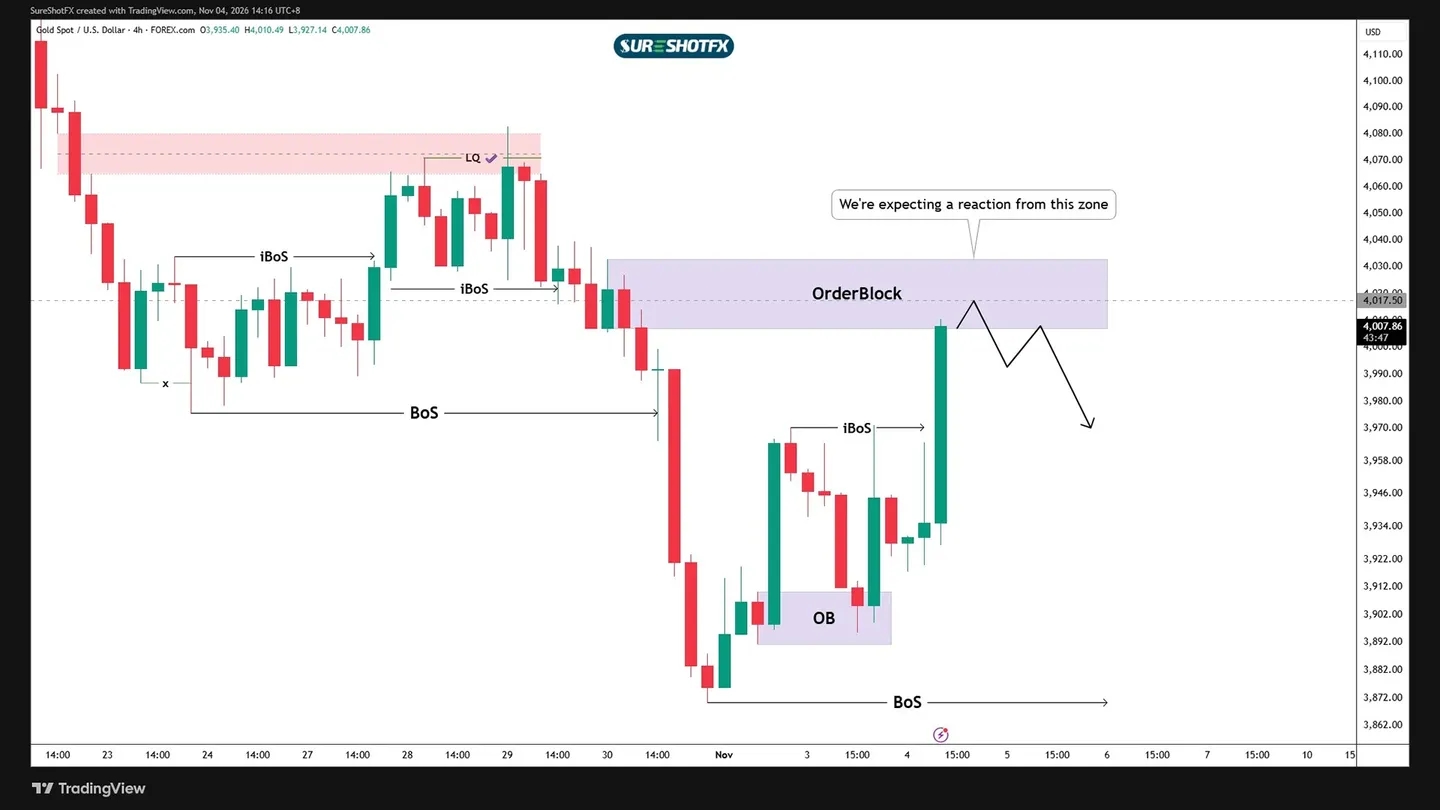
The 4-hour chart for XAUUSD is showing a potential bearish setup. The analysis by the SureShotFX trade team highlights a possible rejection from the resistance zone, suggesting a downside move if selling pressure increases. Traders should watch key price levels for bearish confirmation.
Indices: Wall Street ended October with the Nasdaq Composite at 25,437.00 (about -5.3% for the month), the S&P 500 at 7,580.07 (about -0.9%) and the Dow Jones at 51,770.31 (roughly +1.5% to +1.7%).
On 3 November, election day, the Dow (US30) closed at 51,786.72 (-0.38%), the S&P 500 at 7,568.92 (+0.36%) and the Nasdaq at 25,372.01 (+0.83%) as chip stocks rebounded and Apple weighed on the Dow.
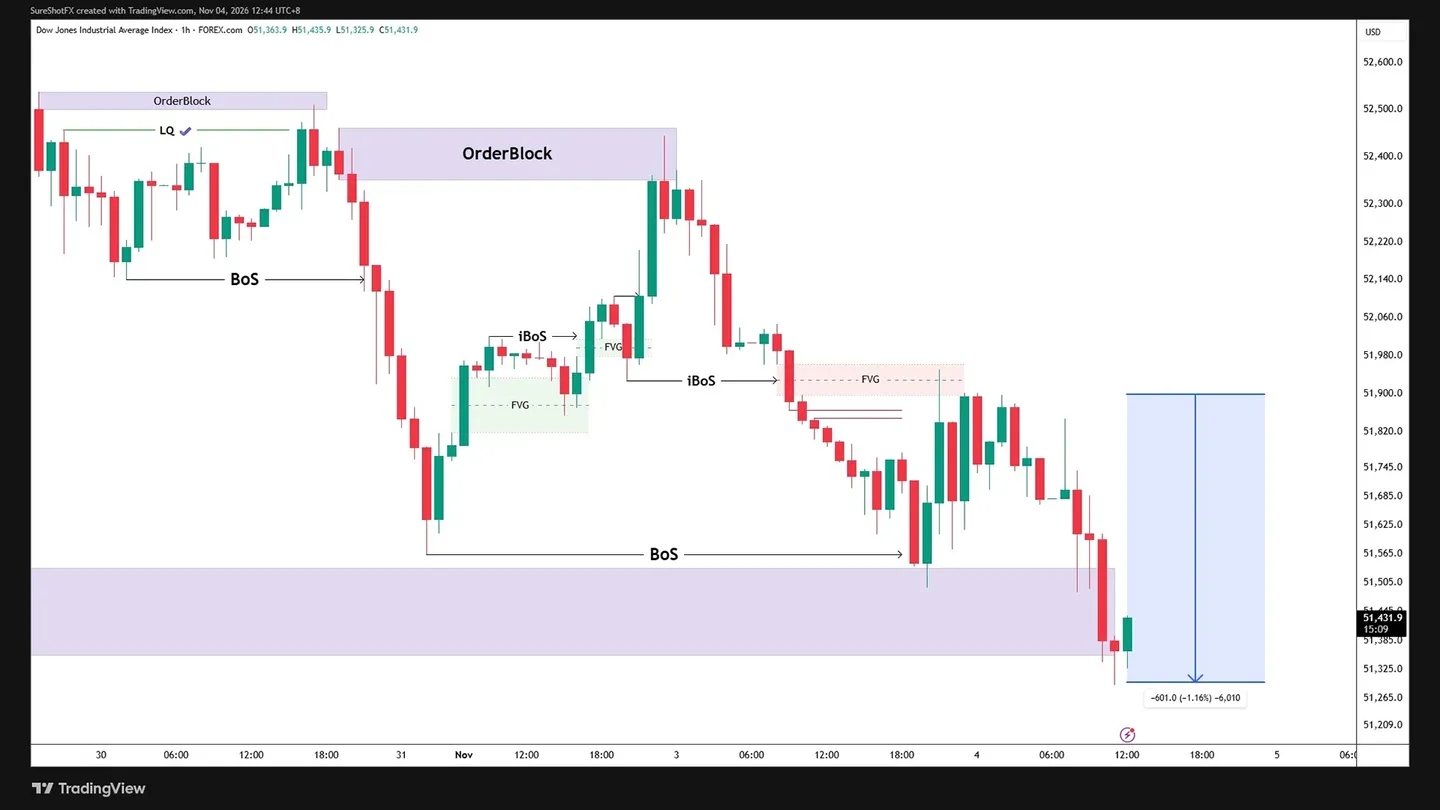
Today, Dow Jones is showing a bearish market structure on the 1-hour chart, with multiple breaks of structure (BoS) and internal breaks of structure (iBoS). After rejecting the supply order block, price continued lower toward a key demand zone. A potential downside move of around 601 points (1.16%) is highlighted, subject to further bearish confirmation.
Cryptocurrency: Bitcoin fell approximately 7.3% in October, while Ethereum declined around 16.1%. Liquidity conditions, institutional flows, and broader risk appetite remain important factors for digital assets.
November 2026 Economic Calendar: Key Events
| Date | News Events | Pair to Watch |
|---|---|---|
| 5 November | Bank of England rate decision | GBP |
| 6 November | US non-farm payrolls | USD, Gold |
| 10 November | US CPI inflation | USD, Gold |
| 18 November | Federal Reserve meeting minutes | USD, Indices |
| 25 November | US GDP (Q3 second estimate) and October PCE data | USD, Indices |
These releases could influence interest-rate expectations and short-term volatility across financial markets. Verify the latest release schedules before positioning around economic announcements.
What Are the Biggest Market Risks in November?
Four developments deserve particular attention this November:
- Persistent inflation: Higher inflation could strengthen expectations of further interest-rate increases.
- Central bank divergence: Different policy decisions from the Fed, BoE, BoJ and RBA could create volatility across major currency pairs.
- Geopolitical developments: Changes in Middle East tensions could affect oil prices, inflation expectations and safe-haven demand.
- Political uncertainty: US midterm election outcomes could influence expectations around government spending, regulation and economic policy.